

 Introduction
Coccidiosis remains one of the most important parasitic diseases affecting commercial poultry. The disease is caused by host-specific Eimeria species that multiply within intestinal epithelial cells, producing intestinal damage, impaired nutrient absorption, reduced growth and, in severe infections, mortality. Its economic impact is linked not only to clinical outbreaks but also to subclinical disease and reduced flock performance (Bera et al., 2010; Sharma et al., 2023; Pal et al., 2023).
Why it matters in modern poultry production
– Rapid multiplication of Eimeria can produce substantial intestinal injury within a short period.
– Subclinical coccidiosis may reduce feed efficiency, growth and flock uniformity without dramatic clinical signs.
– High oocyst contamination of litter increases exposure and repeated infection pressure.
– Effective control requires attention to parasite biology, farm management and appropriate anticoccidial programmes.
Etiology
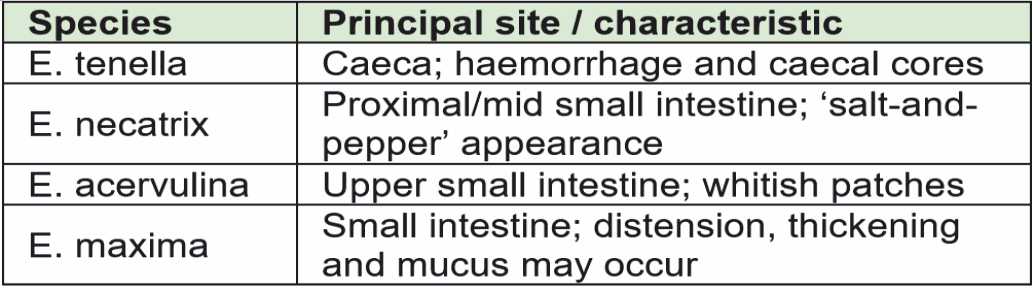
Seven major Eimeria species are recognized in chickens. E. acervulina and E. maxima are frequently encountered, while E. tenella is particularly pathogenic and associated with severe caecal disease and haemorrhage (Yaqub et al., 2023). Species differ in preferred intestinal sites, lesion patterns and pathogenicity.
Transmission
The principal route is faecal–oral transmission. Birds ingest sporulated oocysts from contaminated litter, feed, water, equipment or the environment. Moisture, oxygen and suitable temperature favour sporulation, allowing infective oocysts to accumulate and maintain the infection cycle (Pal et al., 2023).
Life Cycle of EIMERIA
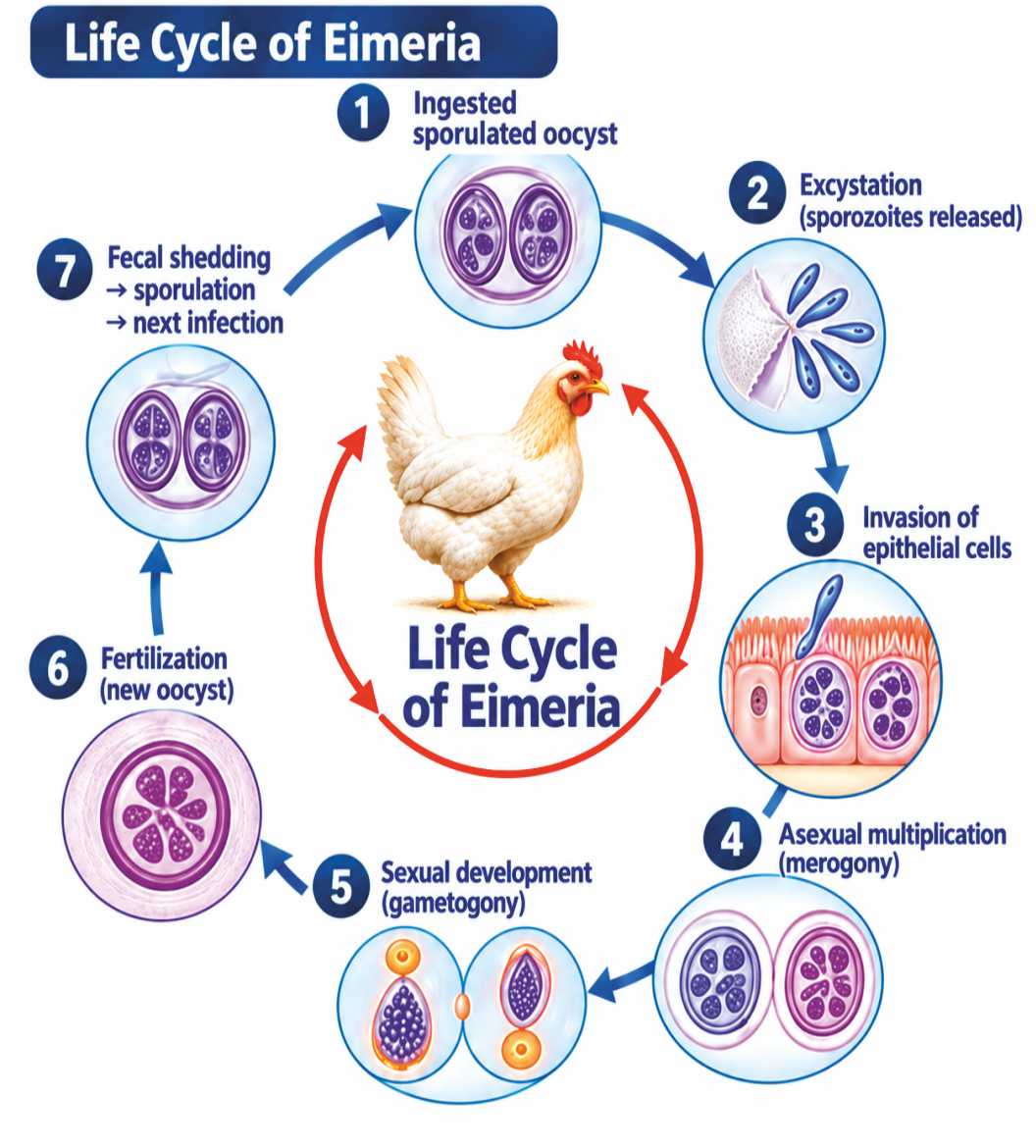
Ingestion of sporulated oocysts → release of sporozoites → epithelial invasion → multiplication → gamete formation → oocyst formation → faecal shedding → environmental sporulation.
Clinical Signs
Severity depends on Eimeria species, infective dose, bird age, immunity and environmental management. Signs include reduced feed intake, depression, ruffled feathers, drooping wings, enteritis, diarrhoea or dysentery, poor growth and increased mortality in severe cases (Pal et al., 2023).
– Reduced body-weight gain and flock uniformity
– Poor feed conversion and production performance
– Diarrhoea or blood-stained droppings in severe infections
– Dehydration, weakness and depression
– Mortality when tissue damage and blood loss are extensive
Species-specific sites
Post-Mortem Lesions
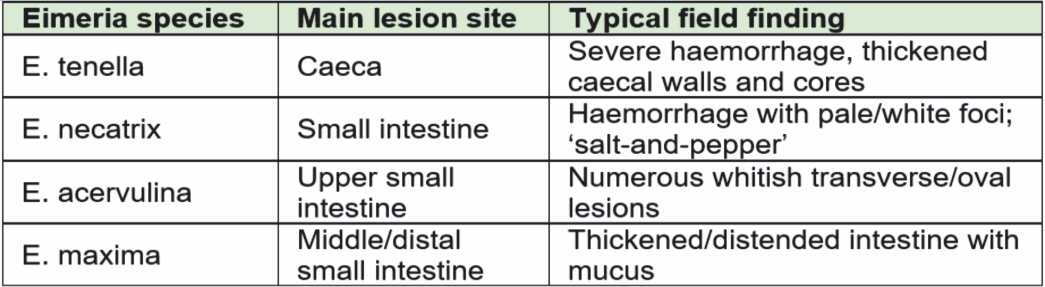
Post-mortem examination helps identify likely Eimeria species and estimate the distribution and severity of intestinal damage. Lesion patterns should be interpreted with clinical findings, litter condition, performance data and, where appropriate, laboratory diagnosis (Pal et al., 2023; Yaqub et al., 2023).
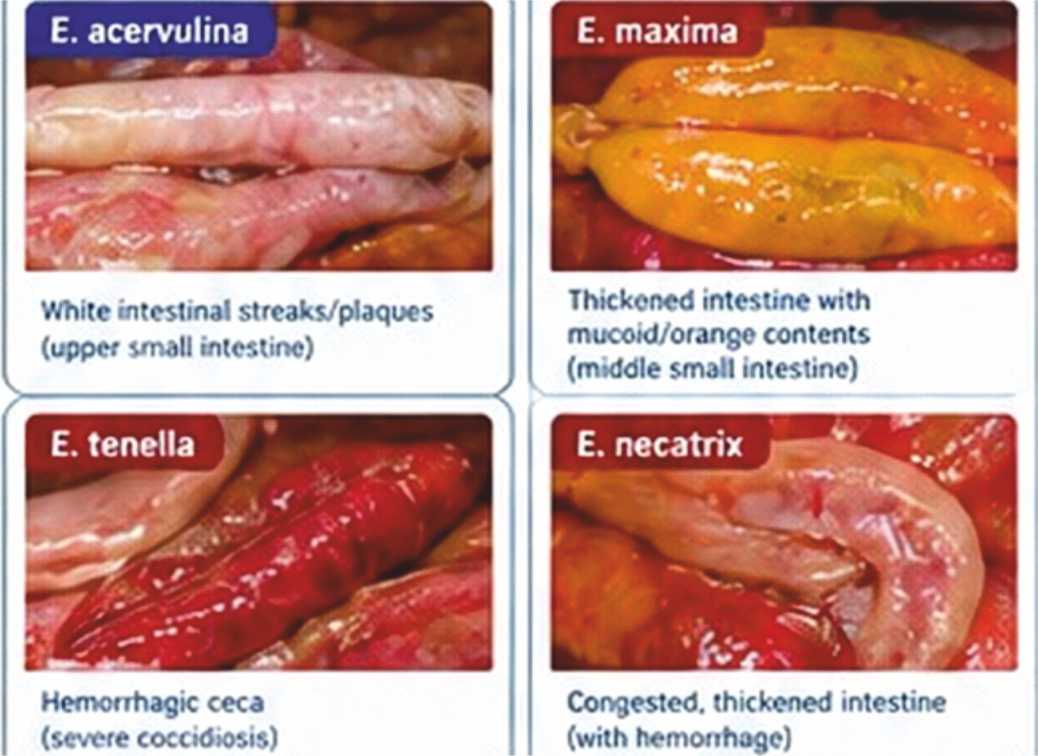
Key lesion patterns
Prevention and Control
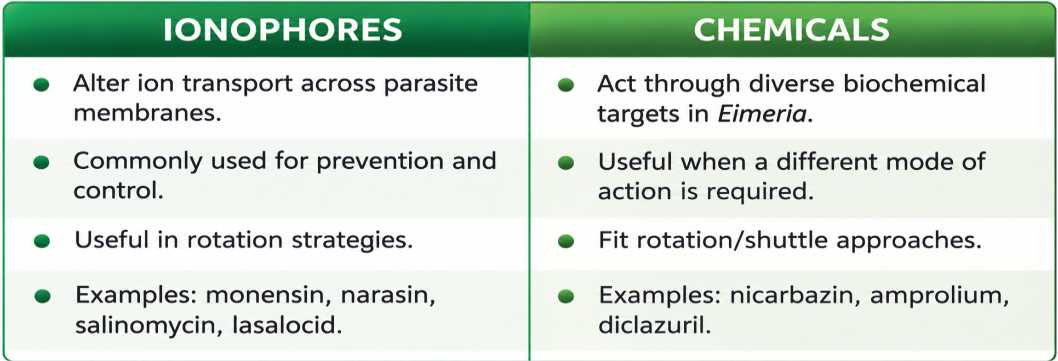
Effective control integrates anticoccidial programmes with litter management, hygiene, stocking-density control, ventilation and sound flock management. Continuous or inappropriate use of a single anticoccidial can contribute to reduced efficacy and resistance selection; rotation, shuttle programmes, combinations and vaccination are among approaches used for longer-term control (Usman et al., 2011; Chapman, 2017; Noack et al., 2019).
Anticoccidial programmes
– Rotation changes the active ingredient or mode of action between production cycles.
– Shuttle programmes use different anticoccidial strategies during different feed phases.
– Combination programmes can broaden anticoccidial activity and may help address reduced sensitivity when appropriately designed (Chapman & Rathinam, 2022).
– Vaccination can provide controlled exposure to selected Eimeria strains and support protective immunity.
Ionophore vs Chemical
Combination programmes
Combining compatible anticoccidial activities can broaden control and reduce dependence on a single mode of action. Programme selection should consider disease pressure, previous anticoccidial history, susceptibility patterns, compatibility and label requirements (Chapman & Rathinam, 2022).
STALLEN’S DUAL APPROACH TO COCCIDIOSIS CONTROL
Stallen South Asia offers a dual approach to coccidiosis management with Manacox Plus, bringing together ionophore and chemical anticoccidial activity in one formulation. This approach is designed to support practical, structured coccidiosis-control programmes while reducing dependence on a single mode of action.
MANACOX PLUS
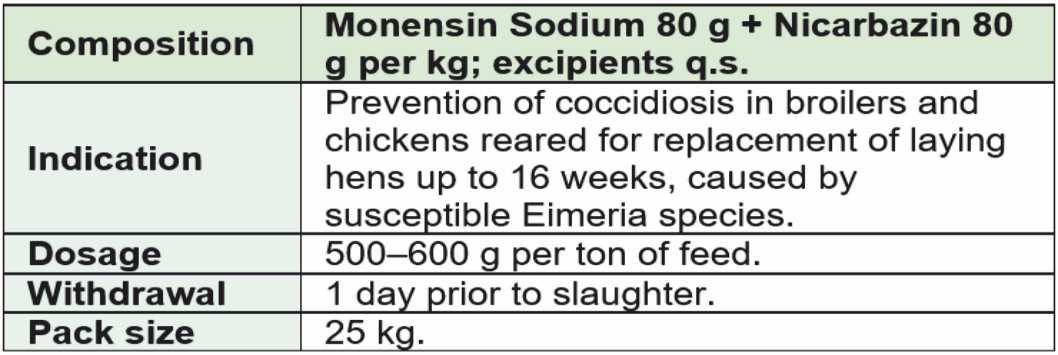
Manacox Plus is a dual-active anticoccidial formulation combining an ionophore and a chemical anticoccidial. It contains Monensin Sodium 8% + Nicarbazin 8% for practical coccidiosis prevention programmes in broilers.
Key Product Points
WHY A DUAL APPROACH
Using monensin sodium together with nicarbazin brings ionophore and chemical anticoccidial activity into one formulation. This can fit structured prevention programmes where the objective is effective control without unnecessary reliance on a single mode of action. Use should follow the approved label and veterinary guidance.
Practical use
– Use within a planned farm coccidiosis-control programme.
– Maintain good litter quality, ventilation, stocking density and drinker management.
– Review anticoccidial history and flock response when planning future programmes.
– Follow approved dose, withdrawal period and compatibility instructions.
References are available on request.