


Ricky Thaper: Let’s begin with the operating context. What makes broiler production in Saudi Arabia different from other markets?
Joseph Biju Kuruvilla: Commercial broiler production in the Kingdom of Saudi Arabia operates under demanding climatic and economic conditions. You have high ambient temperatures, a real need for precise environmental control and intense pressure on both feed efficiency and carcass quality. In that environment, consistent house management stops being a housekeeping issue and becomes a direct determinant of flock performance and farm profitability.
Ricky Thaper: And that is what prompted the comparison you ran?
Joseph Biju Kuruvilla: Yes. We conducted a multi-farm comparison between houses equipped with Poulta’s real-time environmental monitoring platform and comparable non-monitored houses operating under the same production system. The purpose was to quantify the difference in key performance indicators when continuous visibility and rapid response capability were available to farm teams. Everything we published from that exercise is the actual recorded cumulative outcome. No projected, estimated, or generalized industry figures were included.
Ricky Thaper: What exactly was deployed on the monitored houses?
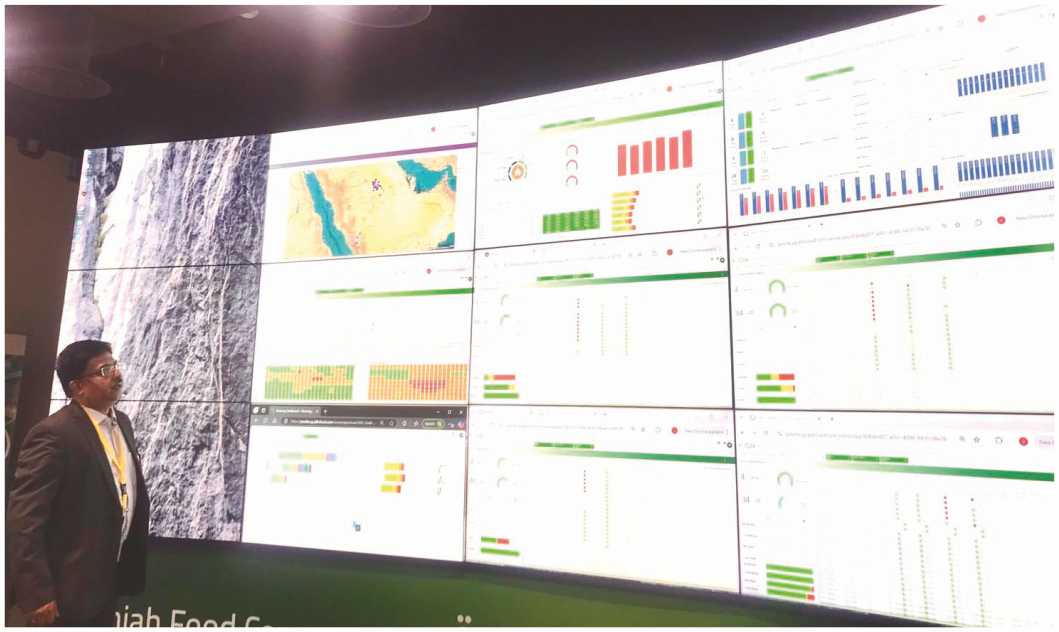
Joseph Biju Kuruvilla: Poulta’s platform provided continuous monitoring of critical environmental parameters together with real-time alerts and performance dashboards. Farm teams received ongoing visibility into house conditions, which let them identify deviations earlier and take corrective action more promptly than is typically possible with conventional, less frequent observation methods.
Ricky Thaper: Was anything else changed on those farms?
Joseph Biju Kuruvilla: Nothing. The system did not alter genetics, feed formulation, or housing infrastructure. The primary operational difference between the two groups was the presence of continuous data visibility and the ability to respond to environmental and performance signals in near real time. That is an important point, because it isolates what the comparison is actually measuring.
Ricky Thaper : Let’s go to the numbers. What did the monitored houses record?
Joseph Biju Kuruvilla: Across the recorded cumulative results, total loss on a farm basis was 3.569% with Poulta against 4.040% without, a reduction of 0.471 percentage points. On a PPL basis, loss was 5.189% against 5.42%, a reduction of 0.231 percentage points. FCR came in at 1.331 against 1.353, an improvement of 0.022 points. Average live weight was 1,356 g against 1,343 g, a gain of 13 g. And B grades fell from 21.71% to 18.165%, a reduction of 3.55 percentage points.
Ricky Thaper: Take the livability figure first. How much does 0.471 percentage points actually matter to a producer?
Joseph Biju Kuruvilla: Lower mortality and culling percentages increase the number of birds that reach market age. On a single house it looks small. Over large placements it compounds into a meaningful increase in total saleable output per cycle, and it does so without any increase in placement density or any change in genetic stock. You are simply losing fewer of the birds you already placed.
Ricky Thaper: The feed conversion result?Joseph Biju Kuruvilla: FCR improved from 1.353 to 1.331. In commercial broiler production, feed is the largest single cost item, so an improvement of this magnitude directly reduces the quantity of feed required to produce each kilogram of live weight. What makes the result credible is that FCR improved while average live weight also increased. The gain was not achieved by harvesting lighter birds. The monitored houses converted feed more efficiently while still delivering higher final weights.
Ricky Thaper: Thirteen grams per bird sounds marginal. Is it?
Joseph Biju Kuruvilla: On a per-bird basis, yes, it is modest. But weight has to be read alongside loss. Higher weight combined with a lower loss percentage increases the total kilograms of live weight produced per house. Multiply that across multiple houses and repeated cycles and the cumulative effect on farm output becomes commercially relevant.
Ricky Thaper: The grading improvement is the largest single movement in the set. Why does that matter so much?
Joseph Biju Kuruvilla: The proportion of B-grade birds fell from 21.71% to 18.165%, a reduction of 3.55 percentage points. A lower B-grade percentage improves the overall product mix delivered to the processing plant and supports better average realization per bird. That is particularly valuable in markets where grade differentials affect pricing and customer specifications, which is very much the case here.
Ricky Thaper: Was there any indicator that moved against you?
Joseph Biju Kuruvilla: No. All four primary indicators moved in a favorable direction simultaneously. The monitored houses recorded lower total loss, more efficient feed conversion, higher average live weight, and an improved grading profile. That pattern of better survival, better conversion, higher weight, and better quality is consistent with tighter environmental control and earlier intervention on emerging issues throughout the production cycle.
Ricky Thaper: How would you summarize the commercial effect for a producer reading this?
Joseph Biju Kuruvilla: Four things. More saleable birds per placement because of reduced total loss. Lower feed cost per kilogram of live weight because of improved FCR. Additional live weight per bird reaching market. And a higher-value product mix through the reduced B-grade percentage. All of it achieved under commercial operating conditions without changes to genetics, feed formulation, or major housing infrastructure.
Ricky Thaper: Does that make the approach easy to scale?
Joseph Biju Kuruvilla: It does, and that is the practical argument. Because the improvements are driven by better information and faster response rather than capital-intensive upgrades, the approach scales across existing commercial complexes. You are not asking a producer to rebuild houses. You are asking them to see what is happening inside the ones they already have.
Ricky Thaper: Your closing thought?
Joseph Biju Kuruvilla: In commercial Saudi broiler operations, the presence of real-time monitoring and the capacity for rapid corrective action were associated with simultaneous improvements in livability, feed efficiency, growth, and carcass quality. The data supports the conclusion that consistent environmental control, enabled by continuous visibility, remains a high-leverage intervention for producers seeking more predictable performance and stronger economic outcomes.
For businesses operating in thermally demanding environments and under tight cost and quality pressure, the ability to see house conditions continuously and act before small deviations become performance losses is a practical route to structural improvement in farm results (Results based on monitored operations. Actual performance may vary).