

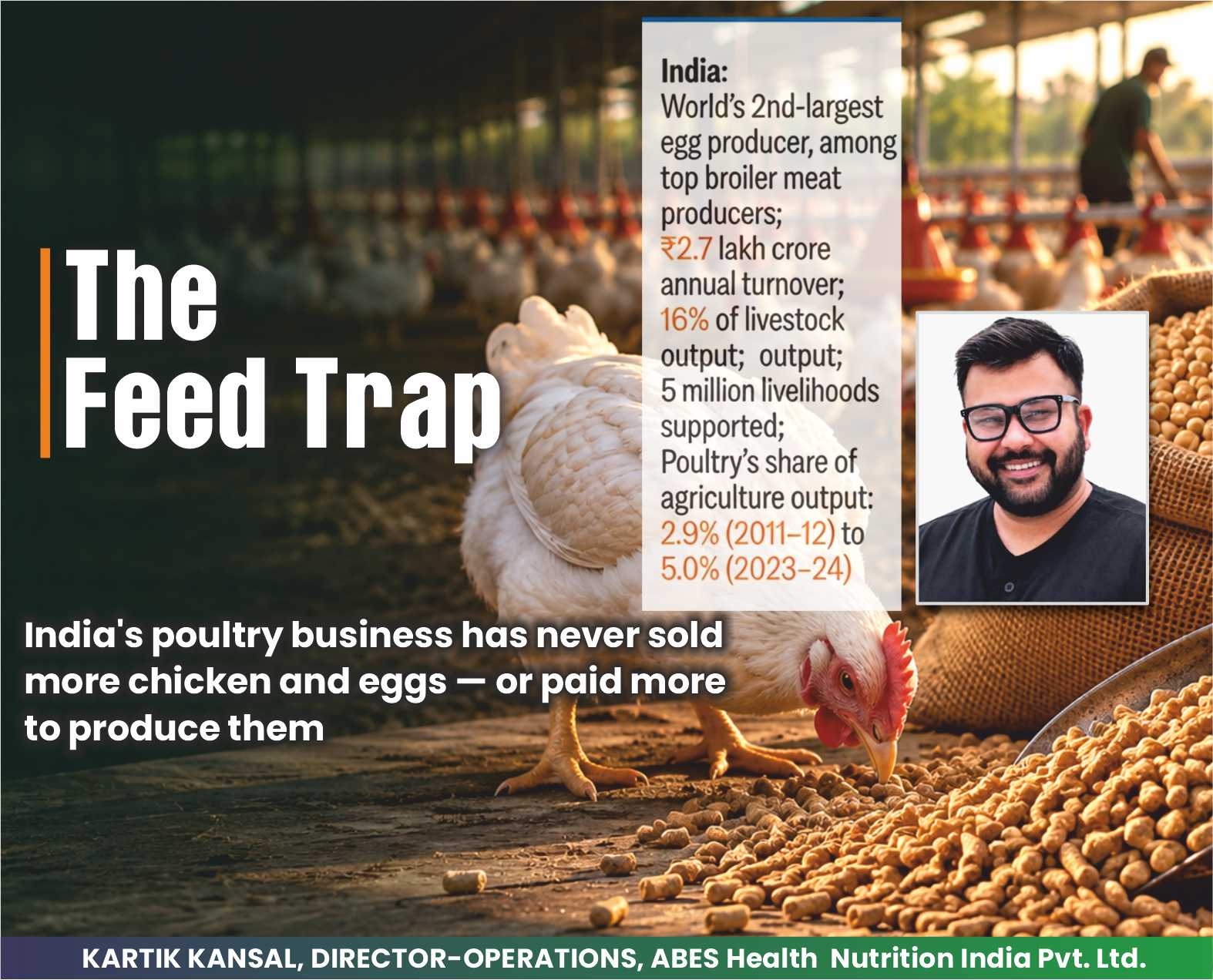
 Walk into any wholesale market in north India this month and you will hear two contradictory stories at the same counter. Traders will tell you that eggs and chicken have rarely commanded better rates. Farmers standing next to them will tell you they are barely making money. Both are right, and the reason is a single line item: feed.
India is now the world’s second-largest egg producer and among the largest producers of broiler meat. The sector turns over roughly ₹2.7 lakh crore a year, accounts for about 16 per cent of livestock output, and supports close to five million livelihoods.
For a business that began as a rural side activity, it has become one of the fastest-compounding parts of Indian agriculture — poultry’s share of agriculture and allied output has climbed from 2.9 per cent in 2011–12 to 5.0 per cent in 2023–24.
A record price season
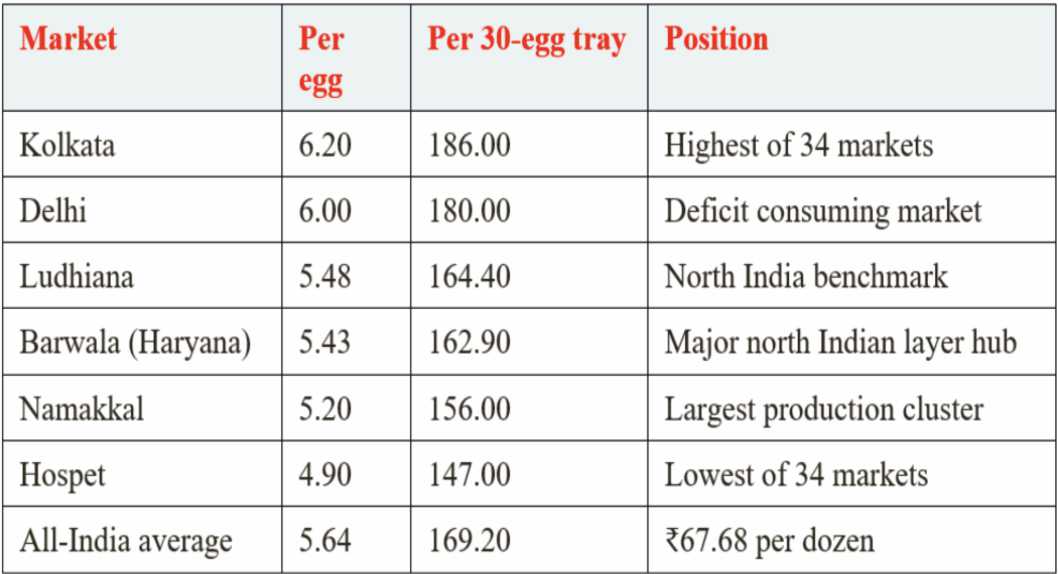
The headline numbers are strong. On 5 September, the National Egg Coordination Committee’s average declared rate stood at ₹5.64 per egg across 34 markets, ranging from ₹4.90 in Hospet to ₹6.20 in Kolkata. Delhi was quoted at ₹6.00, Barwala at ₹5.43 and Ludhiana at ₹5.48. That is a comfortable band for layer farms that were selling below ₹5 through much of last year.
Broilers have swung harder. Farm-gate live bird prices in the Delhi region touched ₹140 a kilogram in July against roughly ₹90 a year earlier, while retail chicken moved from about ₹240 to nearly ₹300 a kilogram. Prices have since cooled as the monsoon supply cycle normalised — north Indian integrators were quoting live bird in the mid-₹90s per kilogram in late August — but the annual average is still tracking well above FY25. Care Edge Ratings estimates broiler realisations recovered about 5 per cent year on year in FY26, with live bird averaging ₹99 a kilogram in February–March 2026, more than 20 per cent above the bird-flu-depressed fourth quarter of Fy25.
Data Box 1 · Necc Egg Rates, 5 September 2026 (₹ Per Egg)
Why the margin is not where the price is
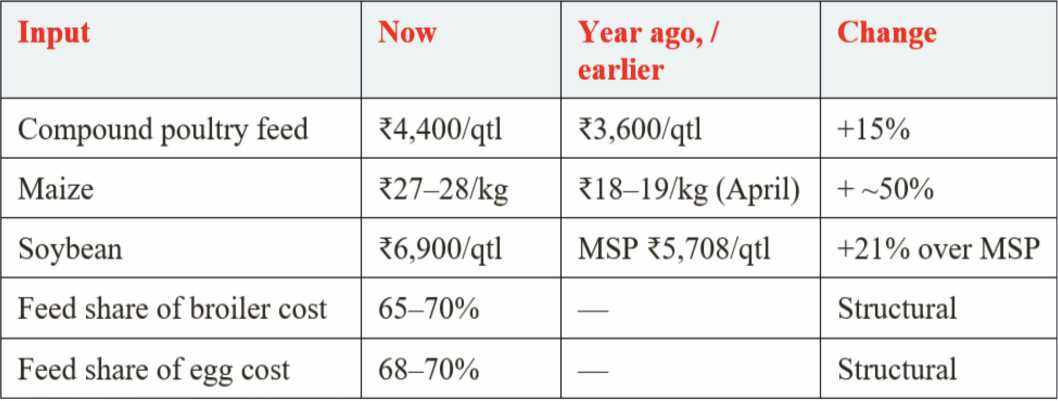
Feed accounts for 65 to 70 per cent of the cost of producing a broiler and roughly 68 to 70 per cent of the cost of producing an egg. In a business with that cost structure, a 15 per cent move in feed wipes out a 10 per cent move in output prices. That is precisely what has happened this year.
Compound poultry feed is now selling at about ₹4,400 a quintal against roughly ₹3,600 a year ago. Maize, the energy backbone of the ration, has moved from ₹18–19 a kilogram in April to ₹27–28 a kilogram. Soybean is ruling near ₹6,900 a quintal, well above the ₹5,708 minimum support price for the 2026–27 season.
Data Box 2 · The Cost Side
Two structural forces are behind the maize spike. First, ethanol. Grain-based distilleries have become a large, price-insensitive buyer of maize, and poultry feed mills are now bidding against a sector backed by a national blending mandate. Nearly 60 per cent of India’s maize output already goes to livestock, with poultry alone accounting for roughly 47 per cent of livestock maize consumption. Second, soybean meal. India is short by an estimated 1.5 million tonnes ahead of the new crop, and soybean acreage this kharif is down 4.5 per cent year on year at 10.6 million hectares.
“India is short an estimated 1.5 million tonnes of soybean meal before the new crop arrives — and soybean acreage this season is down 4.5 per cent.”
The policy knot: imports, GM corn and a farm lobby
The livestock and feed industry have asked the Centre to permit imports of about 1.5 million tonnes of soybean meal to bridge the gap. The soybean processing industry has opposed the move, arguing that domestic supply is adequate and that imports would discourage farmers from expanding oilseed acreage. It is a familiar standoff: the same protein deficit, the same two lobbies, a different year.
Poultry industry representatives have also pressed for approval of genetically modified corn, on the argument that higher-yielding maize would give both the feed and ethanol industries cheaper raw material. Under this year’s trade arrangement with the United States, India retained protection on corn and soybean — both predominantly GM crops there — while agreeing to allow imports of distillers’ dried grains and red sorghum for animal feed. That is a partial valve, not a solution. DDGS can replace part of the energy component of a ration; it cannot replace the protein that soybean meal supplies.
For business readers, the policy question is simple to state and hard to settle: India cannot simultaneously run an aggressive ethanol programme, protect oilseed growers from imports, and supply a poultry sector growing at 7 to 8 per cent a year with cheap feed. Something has to give, and so far, the adjustment has been borne by poultry farmers and, downstream, by consumers.
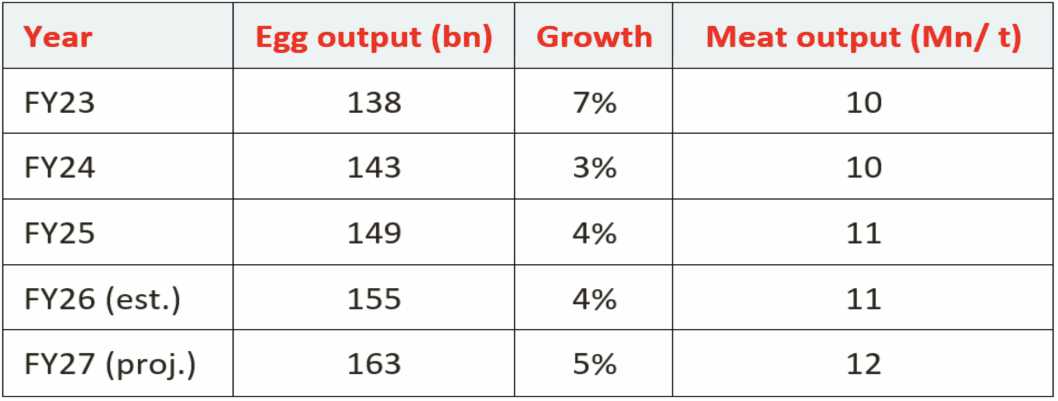
Volumes keep climbing anywayRemarkably, none of this has slowed production. India produced 149.11 billion eggs in 2024–25, second only to China, with commercial farms accounting for about 84.5 per cent of output and backyard poultry the rest. CareEdge estimates egg output at around 155 billion in FY26, rising to roughly 163 billion in FY27, with total meat production moving from about 11 million tonnes to 12 million tonnes over the same period.
Data Box 3 · Production Trajectory
 Poultry India puts broiler production growth at 6 to 7 per cent a year for 2026–27, concentrated in Andhra Pradesh, Tamil Nadu and Telangana, with the layer segment expanding more moderately on the back of productivity per bird, automation and value-added products. Andhra Pradesh alone accounts for 18.4 per cent of national egg output, Tamil Nadu 15.6 per cent and Telangana 13.0 per cent; the top five states together produce 64.4 per cent of India’s eggs.
Exports remain a modest but real business. India shipped poultry products worth USD 317.79 million in FY26, with the UAE, Oman, Maldives, Indonesia and Japan the leading destinations. Against a sector of roughly USD 31 billion, exports are still a rounding error — which is itself the opportunity, constrained mainly by disease-free-zone certification and processing infrastructure.
The demand headroom argument
The most persuasive case for investing in Indian poultry is not this year’s price cycle. It is the consumption gap. Per capita egg availability is around 100 to 105 eggs a year against the National Institute of Nutrition’s recommended 180. Per capita chicken consumption is roughly 5 kg a year against a global average close to 17.5 kg. Industry estimates suggest that a one-kilogram rise in per-person chicken consumption would add about 1.43 million tonnes of annual demand.
That headroom is being converted by three commercial forces rather than by policy: quick-service restaurants, organised retail, and the shift from live-bird wet markets to chilled and frozen products. Vertically integrated producers — who own the hatchery, the feed mill, the contract farms and increasingly the processing plant — have been the main beneficiaries, because integration is what buffers a business against the feed-price whiplash described above.
The value-of-output data makes the compounding visible. Poultry meat and eggs generated about ₹56,200 crore of output in 2011–12. By 2023–24 that figure was ₹2.67 lakh crore — a growth rate of 9.3 per cent a year for meat and 6.1 per cent for eggs, against 5.3 per cent for milk and 2.1 per cent for cereals.
“Poultry’s share of agriculture and allied output has risen from 2.9 per cent to 5.0 per cent in twelve years. Few segments of Indian agriculture have compounded faster.”
The recurring tax: disease and weather
Avian influenza remains the sector’s single largest tail risk, and 2026 has been an active year. India reported eleven H5N1 outbreaks on farms in Kerala in December, killing roughly 54,100 birds. In February, about 6,000 birds were culled at a research centre in Patna, with movement restrictions imposed across a nine-kilometre surveillance zone. In March, more than 22,000 birds were culled in Bilaspur district of Chhattisgarh, and in April Karnataka reported its first case of the year at a farm near Bengaluru.
The direct culling loss is rarely the biggest cost. The bigger hit is the demand shock: consumers step away from chicken for several weeks after every widely reported outbreak, and prices in unaffected states fall alongside those in affected ones. Q4 FY25 was a textbook case, and the strong February–March 2026 realisations look impressive partly because they are measured against that depressed base.
Weather has compounded the problem this season. A prolonged heat wave followed by a delayed and unevenly distributed monsoon raised bird mortality and cut egg production in several states, adding to the cost per marketable bird. For layer units, higher mortality in an inflated-feed environment is a double penalty: the feed has already been consumed before the bird is lost.
The industry’s answer, so far, is largely defensive — stronger vaccination protocols, farm-level biosecurity training and surveillance, alongside a push for indigenous vaccine development that would reduce cost for small and mid-sized farms.
What the ratings agencies see
For all the noise, the credit view is constructive. CareEdge describes FY26 as a year of stabilised operating performance — healthy production growth, resilient demand across retail, institutional and food-service channels, improved supply-demand balance and a recovery in profitability with a strong finish in the fourth quarter. Its FY27 outlook for the sector is stable.
The distinction worth drawing is between the organised and unorganised halves of the industry. Integrators with feed-buying scale, forward contracts and processing margins have ridden the cost cycle. Independent broiler and layer farmers, who buy feed at spot and sell birds at spot, have absorbed it. That gap is quietly accelerating consolidation — the most consequential structural trend in the sector right now, and one that will show up over the next few years in contract-farming penetration and in capital-market activity among the larger integrators.
Public support remains focused on the entrepreneurial end. The National Livestock Mission continues to offer a 50 per cent capital subsidy for parent farms, rural hatcheries and brooder-cum-mother units, aimed at small and rural producers rather than at large integrators. It builds capacity; it does not address the feed-price problem that is currently setting margins.
What to watch for the rest of FY27
• The soymeal decision. Whether the Centre permits the 1.5 million tonne import the livestock industry has requested is the single biggest swing factor for margins this year.
• New-crop maize and soybean arrivals. A good kharif arrival could pull feed back toward ₹4,000 a quintal; a poor one locks in current costs through the festive season.
• Ethanol demand for maize. The structural competitor for feed grain is not going away and will keep a floor under maize prices.
• Winter avian influenza. Outbreak seasonality peaks between December and March. Watch for demand shocks rather than culling losses.
• Festive and winter demand. Egg consumption typically strengthens from October, which should support NECC rates even if feed stays elevated.
• Consolidation and capital. Cost pressure is a filter. Expect more contract farming, more integration, and more interest in the sector from public and private capital.
“The bottom line for anyone with capital in this business: India’s poultry demand story is intact and structurally under-served, but 2026 has demonstrated that returns in this sector are set on the input side, not the output side. The operators who will do well over the next eighteen months are not the ones betting on higher chicken prices. They are the ones who have solved for feed.”
References are available on request.