


Monsoon Broiler Management: Mitigating Humid-Heat Stress
Dr. Sikander1, Dr. Pooja Kundu2 and Dr. N K Mahajan3
1M.V.Sc student, Department of Veterinary Pathology, LUVAS Hisar,
2Veterinary Surgeon, Department of Animal Husbandry & Dairying, Govt. of Haryana,
3Retd. Professor and Dean, LUVAS Hisar.
Monsoon brings a unique and formidable set of challenges for commercial poultry farming. As monsoon advances, ambient temperatures remain high while relative humidity level also increases, flocks face dangerous dual threat of severe humid-heat stress and a higher prevalence of systemic viral infection with respiratory manifestations – such as Infectious Bronchitis Virus (IBV), Newcastle Disease Virus (NDV), or Low pathogenic Avian Influenza (LPAI) and Multi Drug Resistance Avian pathogenic E coli (MDR-APEC). Unlike mammals, birds lack sweat glands and rely on panting (evaporative cooling) and behavioral mechanisms like seeking shade, gular fluttering and standing in cool areas to regulate their body temperature. When relative humidity increases defense mechanism fails entirely, the consequences extend far beyond a drop in performance. Humid- heat stress triggers systemic physiological disruptions that compromise the intestinal barrier, suppress the immune system, and open the floodgates for opportunistic infections and catastrophic mortality.
Effectively managing a poultry farm requires a proactive approach balancing environmental humidity control, intensive litter management, strict water sanitization, and precise nutritional adjustments.
1. Environmental &Ventilation Control
Primary challenge is no longer just cooling the air, but moving moisture away from the birds and preventing the shed from becoming hot and humid.
· Stocking Density: Maintain strict reduction in stocking density by 10% to 15% compared to winter baselines. Allowing extra floor space per bird is critical during high-humidity periods to minimize micro-climate heat accumulation between individuals.
· Ventilation and Operational Air Velocity: Ensure that fans are running at peak efficiency. In environmentally controlled (EC) sheds, maintain an air velocity of at least 2.5 to 3.0 meters per second directly across the birds. Because evaporative cooling drops in efficiency when relative humidity exceeds 70%, farmers must rely on the wind-chill effect (convective cooling) to strip heat from the birds’ bodies. Regularly check house manometers. Maintain static pressure within the optimal 0.08 to 0.12 inches of water column depending on house width. High static pressure indicates restricted air inlets (clogged pads), causing fan motors to overheat and air speed to drop. Low static pressure indicates structural air leaks (loose curtains or unsealed doors), which causes short-circuiting of air currents and dead air spaces.
· Evaporative Cooling Pads: On high humidity days when relative humidity exceeds 70–75%, turn off the water pumps to the pads completely. Running water over the pads when air is already saturated will not lower temperature; it will only increase humidity, exacerbating respiratory distress. Run exhaust fans at maximum capacity to maximize pure wind velocity. Clean pads regularly with descalants to remove dust and monsoon-induced mold or algae blooms.
· Internal Fogger Restrictions: For open-sided poultry houses, discontinue use of internal low-pressure foggers entirely during rainy or high-humidity days. Fogger droplets will fail to evaporate in mid-air, falling directly onto the litter, causing wet floors, severe ammonia release, and coccidiosis outbreaks. High-pressure systems (400–600 PSI) should only be cycled briefly if dry, hot spells occur.
2. Water Security & Quality Management
Warm, humid monsoon conditions cause rapid bacterial proliferation and heavy biofilm formation in pipeline networks. Since water consumption remains high, biological water security is critical.
· Water Acidification and Sanitization: Efficacy of chlorine-based sanitizers is fundamentally tied to pH. In alkaline water (pH above 7.5), chlorine converts primarily into hypochlorite ions (OCl-), which are highly inefficient at killing bacteria. By utilizing organic acidifiers (Formic, Propionic, or Citric acid) to maintain an optimized, acidic water pH of 5.5 to 6.5, chlorine converts instead into hypochlorous acid (HOCl). This active form is up to 80 times more effective at destroying bacterial cell walls, preventing water lines from becoming breeding grounds for E. coli and Salmonella.
· Water Temperature Regulation: Particularly during hot spells birds will reject water if it is too warm (more than 22°C). Overhead water storage tanks must be fully shaded, or completely insulated with glass wool or local materials like gunny bags. Flush water lines regularly during the day to clear standing warm water and deliver cool, clean water to the nipples.
· Water Line Biofilm Removal: Between bird batches, or as a quick preventative step, water lines must be deeply cleaned to break down slimy bacterial buildup (biofilm). To do this, fill the pipe system with a 1–2% mix of hydrogen peroxide stabilized with silver nitrate. Leave this solution sitting still in the pipes for 4 to 6 hours so it can chemically dissolve the organic matrix completely. Immediately after; flush the lines thoroughly with high-pressure fresh water to wash away all the loosened dirt and leftover chemicals before the new chicks arrive.
3. Nutritional Adjustments & Electrolyte Therapy
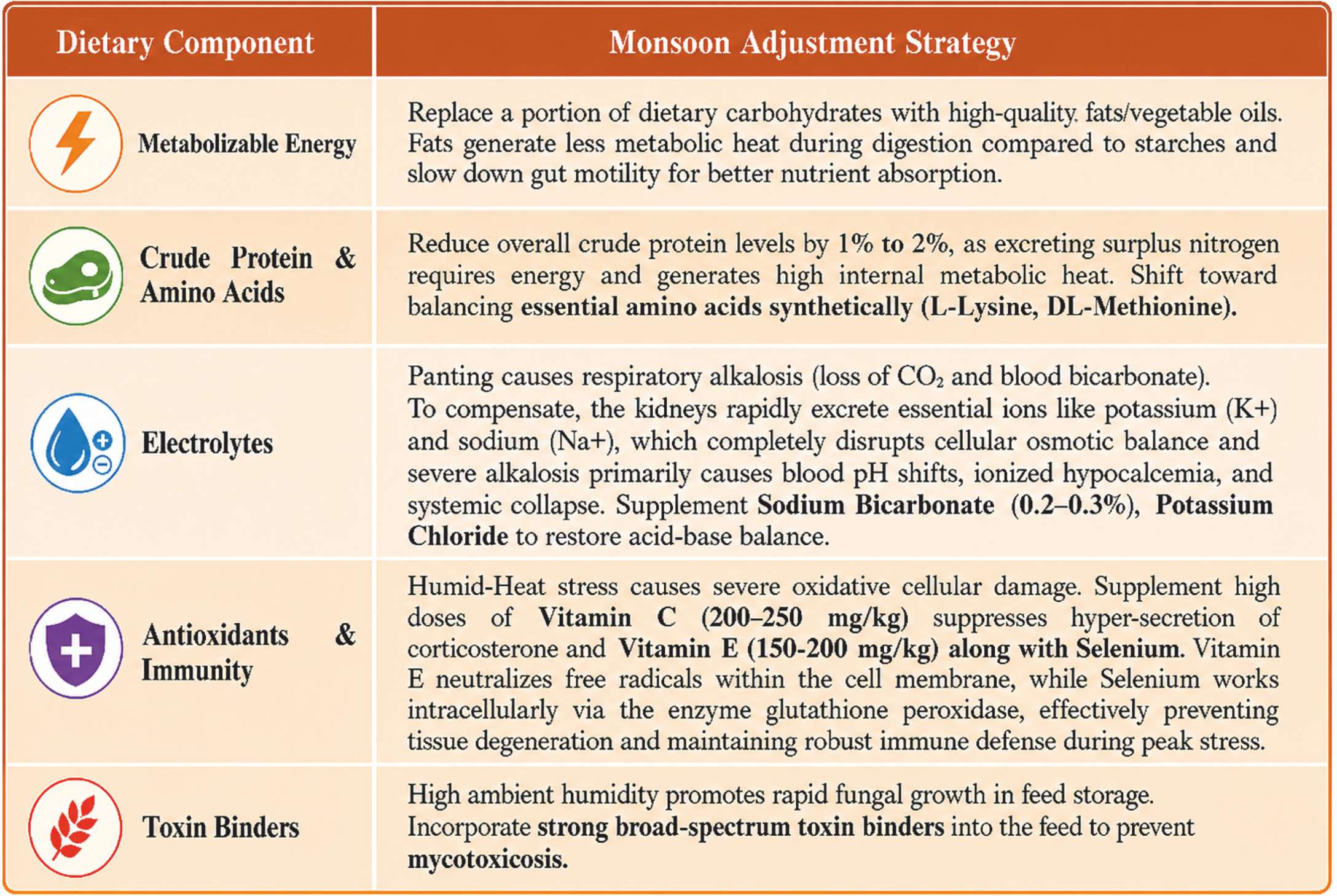
In humid weather, broilers voluntarily reduce feed intake to minimize the metabolic heat generated by digestion. Feed consumed must be nutrient-dense but easy to metabolize.
4. Operational Practices
Minimizing physical and physiological stress and preserving litter quality are vital to avoiding sudden spikes in mortality.
· Feeding Schedule: Do not feed the birds during hottest, most humid hours of the day (typically 11:00 AM to 4:00 PM). Shift feed distribution to early morning/late evening when ambient conditions are more favorable. This prevents the peak of metabolic digestion from coinciding with the peak of environmental stress.
· Intensive Litter Management: Litter management is highly critical. Wet, caked litter undergoes rapid anaerobic fermentation, releasing toxic ammonia gas (NH3). Ammonia damages the protective cilia in the bird’s respiratory tract, leaving them highly vulnerable to viral infections (IBV/NDV). Rake the litter regularly during dry periods, add agricultural gypsum or alum to control ammonia release, and immediately replace wet patches with dry, pre-treated rice husk or sawdust.
· Zero Disturbances: Avoid shifting birds, vaccinations, flock grading, litter raking, and mortality collection, or weighing during peak heat hours. Any forced physical activity compels the birds to generate more internal metabolic heat load, which can quickly trigger acute heat stroke and fatal cardiovascular arrest.
Key Dietary Implementations
5. Critical Emergency Protocol:
· Assess Humidity and Disable Water Inputs: Immediate Check the relative humidity. If it is above 70%, ensure all cooling pad pumps and internal foggers are turned off immediately. Introducing more water vapor into saturated air will accelerate mortality.
· Maximize Wind Velocity: Within 2 minutes.
Override automated fan settings and force all exhaust fans to operate at 100% capacity. Achieve maximum operational air velocity (greater than 3.0 m/s) to maximize heat dissipation via the wind-chill effect.
· Charge Water Lines with Electrolytes: Within 10 minutes.
Ensure that cool water (under 22°C) infused with highly concentrated electrolytes—specifically Potassium Chloride and Sodium Bicarbonate—is fully charged into the drinking lines to combat respiratory alkalosis.
· Enforce Absolute Shed Calm: Continuous
Cease all human movement inside the shed. Do not collect mortality, adjust curtains, or walk along the lines during the crisis, as forcing a heat-stressed bird to stand up can induce instant heart failure.
Summary for Monsoon Management: Successful monsoon poultry management requires a complete shift from evaporative cooling to heavy wind-chill ventilation, aggressive litter moisture controls, and feed protection against molds. Managing the farm proactively before seasonal humidity peaks eliminates induced physiological stress, secures optimal feed conversion ratios (FCR), and safeguards overall farm profitability.