

Empowering Poultry Farming in India with Smart Technologies and Sustainable Practices
Dr. Pawar Rutik Namdev1 (MVSc Scholar), Dr. Shipra Tiwari1 (MVSc Scholar)
1Department of Livestock Products Technology,
College of Veterinary Science and Animal Husbandry, DUVASU Mathura (281001), India
Introduction
India’s poultry farming sector is one of the fastest-growing segments of agriculture, transitioning from small-scale backyard flocks to an organized, technology-driven industry. Today, India ranks as the third-largest producer of eggs and fifth-largest producer of broiler meat globally, contributing significantly to nutritional security, rural livelihoods, and export earnings. The adoption of innovative technologies and sustainable practices is the driving force behind this transformation. The convergence of automation, biotechnology, artificial intelligence (AI), Internet of Things (IoT), and renewable energy solutions is redefining efficiency, profitability, and animal welfare in Indian poultry production.
1. Automation and Environmental Control Systems
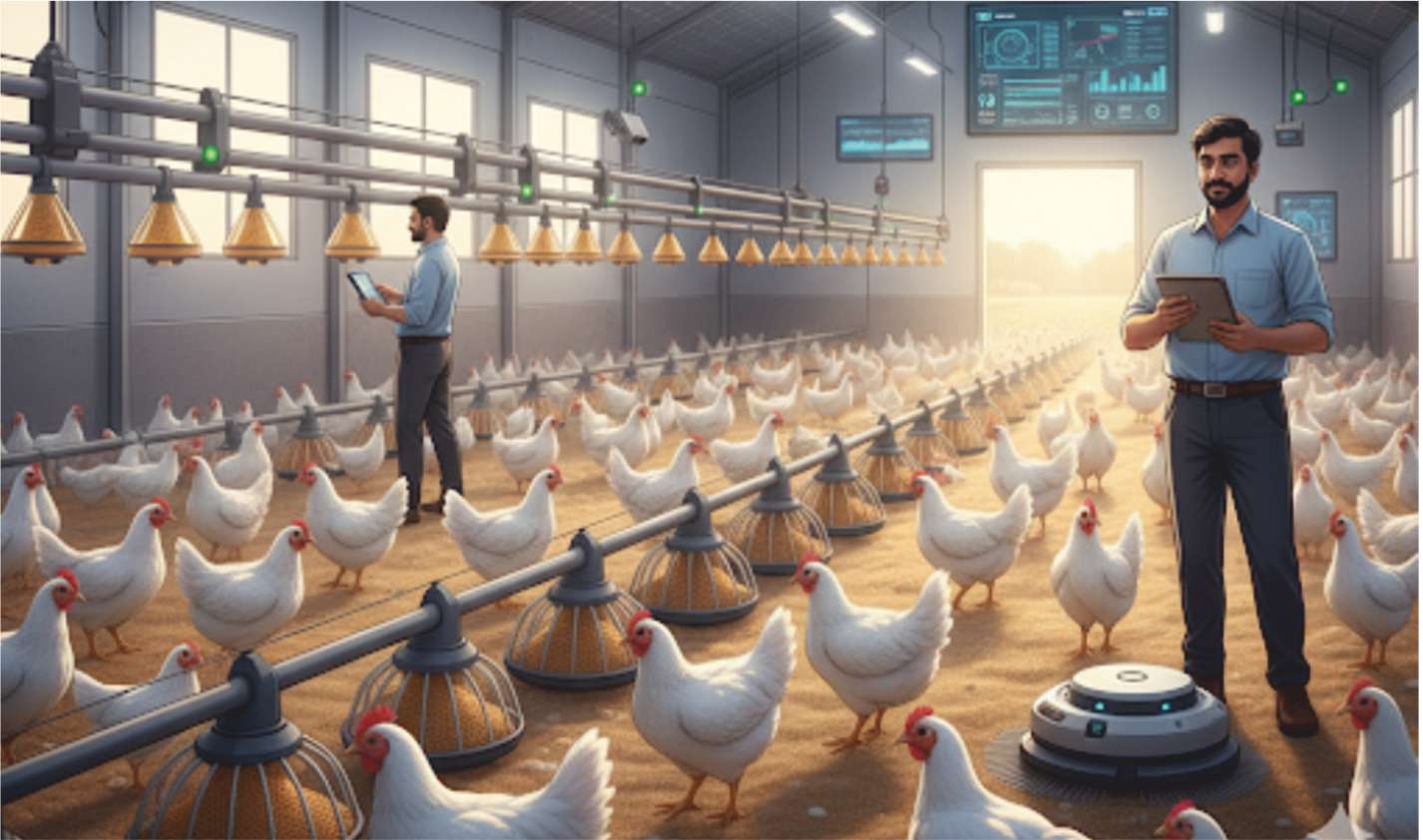
Modern poultry farms increasingly rely on automatic feeders, nipple drinkers, robotic cleaning systems, and conveyor-based egg collection. Climate-controlled housing systems use tunnel ventilation, cooling pads, and heating systems to maintain optimal growth conditions year-round. IoT-enabled climate controllers adjust temperature, humidity, and lighting schedules automatically. Case example: A large poultry farm in Tamil Nadu reported a 15% improvement in feed conversion ratio (FCR) and 12% lower mortality after adopting IoT-based environmental monitoring.
2. AI and IoT for Health and Productivity Monitoring
AI-powered surveillance systems analyze movement patterns, vocalization changes, and feeding behavior to detect early disease signs. IoT sensors track feed and water intake, body weight, and environmental parameters in real time, alerting farmers via smartphone apps. Global Insight: In Japan, smart poultry houses with AI-based monitoring achieve over 95% accuracy in predicting disease outbreaks 48–72 hours before visible symptoms appear — a model now being adapted in Indian research centers.
3. Sustainable Feeding Solutions and Waste Utilization
Feed constitutes 70% of production costs, making feed innovation a critical area. Innovations include:
– Black Soldier Fly larvae meal — high protein, produced from organic waste.
– Algal biomass — boosts omega-3 content in meat and eggs.
– Enzyme-enriched feeds — improve nutrient absorption.
– Crop residue-based feed formulations — reduce costs and waste.
Impact: Lower costs, enhanced nutritional quality, and improved environmental sustainability.
4. Vertical Integration and Supply Chain Efficiency
Leading companies like Suguna Foods, Venky’s, and Godrej Tyson operate fully integrated supply chains — controlling breeding, feed milling, hatcheries, grow-out farms, processing, cold chain logistics, and retail sales.This ensures biosecurity, quality consistency, and traceability while supporting contract farmers with inputs and technical guidance.
5. Biotechnology and Genetic Advancements
Advanced breeding programs use CRISPR-Cas9, marker-assisted selection, and QTL mapping to produce birds with higher productivity, disease resistance, and adaptability to India’s climate. Example: Dual-purpose breeds like Vanaraja and Gramapriya — developed by ICAR — thrive in rural, low-input systems while producing 180–200 eggs annually alongside quality meat.
6. Antibiotic-Free Production and Biosecurity Innovations
The shift toward antibiotic-free poultry production is gaining momentum through:
– Farm-specific vaccination programs.
– Probiotic and phytogenic additives like oregano oil and neem extracts.
– Strict biosecurity protocols — footbaths, controlled farm access, and vehicle disinfection.
7. Blockchain, RFID, and Digital Traceability
Blockchain-backed farm-to-fork tracking ensures that consumers can verify a product’s origin, quality, and safety. RFID-tagged batches enable instant recalls in case of contamination.
8. Renewable Energy and Eco-Friendly Practices
Sustainable poultry farms are implementing:
– Solar panels to power fans, lights, and heating.
– Biogas digesters to convert manure into usable energy.
– Rainwater harvesting and water recycling for operations.
Case Example: A Maharashtra farm reduced electricity costs by 40% after installing a rooftop solar plant and biogas unit.
9. Government and Institutional Support
Government initiatives such as the National Livestock Mission (NLM), Poultry Venture Capital Fund, and ICAR-led AICRP on Poultry Breeding have accelerated technology adoption. Subsidies for equipment like solar panels, hatchery automation, and cold chain infrastructure are making modernization accessible to small and medium-scale farmers.Training programs by Krishi Vigyan Kendras (KVKs) and state veterinary universities ensure that farmers can adopt and maintain new technologies effectively.
10. Global Best Practices and India’s Adoption
Internationally, countries like the Netherlands, the US, and Brazil have long embraced precision poultry farming — a data-driven approach that integrates AI, robotics, and real-time analytics. India is adapting these practices to local conditions and cost constraints, ensuring scalability for farms of all sizes.
11. Future Trends and Opportunities
The next wave of innovations in Indian poultry farming may include:
– Robotic farm assistants for cleaning, egg collection, and surveillance.
– Wearable health trackers for breeder birds.
– Fully automated AI-driven hatcheries for precision chick management.
– Advanced climate-resilient poultry housing to withstand extreme weather events.
– 3D imaging and AI for carcass yield optimization in processing plants.
12. Regional Success Stories: Innovation at the Grassroots
While large corporates drive vertical integration, many small and medium poultry farmers are embracing low-cost tech solutions with significant results.
– Andhra Pradesh: Farmers use low-energy tunnel ventilation systems designed by local engineering colleges, reducing summer mortality by 20%.
– Kerala: Co-operative societies invest in solar-powered incubators, enabling village-level chick production and reducing dependency on urban hatcheries.
– Punjab: Backyard poultry programs using Vanaraja and Gramapriya breeds help women farmers earn ₹15,000–₹20,000 annually from egg sales alone.
These success stories highlight that technology adoption is scalable — from backyard to industrial scale.
13. Start-Up Innovations Driving Change
India’s agri-tech start-ups are entering poultry farming with AI-driven farm management apps, e-commerce feed platforms, and precision health tools.
– Eggoz – Uses IoT-based farm monitoring for premium “antibiotic-free” eggs with QR-coded traceability.
– PoultryMon – Offers sensor-based farm health and productivity analytics.
– Kheyti – Introduces low-cost modular poultry shelters for climate-resilient small-scale farming.
Start-ups are bridging the gap between traditional farming and high-end technology, making advanced tools affordable and accessible.
14. Export Opportunities for Indian Poultry Products
India’s poultry exports (mainly hatching eggs, table eggs, and frozen chicken) have strong demand in Middle Eastern, African, and Asian markets.
Innovations in cold chain logistics, biosecurity compliance, and product quality assurance are enabling Indian producers to compete internationally.
Key Factors Boosting Export Potential:
– Adoption of Global G.A.P. certification for biosecurity and welfare.
– Processing innovations for value-added products like pre-cooked chicken.
– Government-backed export incentives under APEDA (Agricultural and Processed Food Products Export Development Authority).
15. Challenges and Pathways to Overcome Them
Despite progress, the sector faces challenges:
Challenges
– Feed cost volatility due to climate-driven crop fluctuations.
– Biosecurity threats from avian influenza outbreaks.
– Gaps in cold chain and logistics for rural production clusters.
– Limited financing options for small-scale modernization.
Solutions
– Development of alternative protein sources (insects, algae, single-cell proteins).
– Regional disease surveillance networks linked via AI dashboards.
– Public-private investment in cold chain and processing hubs.
– Microfinance and government-backed credit schemes for smallholder poultry farmers.
16. The Road Ahead: Towards Smart, Sustainable, and Inclusive Poultry Farming
The future of Indian poultry farming lies in integrating technology with inclusivity — ensuring that innovations reach small and marginal farmers alongside industrial players. With AI-driven analytics, IoT-enabled health monitoring, climate-resilient infrastructure, and renewable energy adoption, India can position itself as a global leader in sustainable poultry production.
If the sector continues on this trajectory, poultry farming in India could become:· Economically stronger – by reducing costs and increasing market access. · Environmentally responsible – through renewable energy and waste recycling.
– Socially empowering – by creating livelihoods, especially for rural women.
Conclusion
India’s poultry farming sector is undergoing a historic transformation, shifting from traditional backyard systems to a highly organized, technology-enabled, and market-oriented industry. Through automation, AI, IoT-based monitoring, sustainable feed innovations, genetic advancements, blockchain-enabled traceability, and renewable energy integration, productivity is rising while environmental impact is being reduced. Government support, institutional research, and the rise of agri-tech start-ups have accelerated technology adoption not just among large integrated players but also among small and medium-scale farmers. Regional success stories prove that innovation is scalable and adaptable to local needs.

The sector’s future lies in smart, sustainable, and inclusive growth — where advanced tools are accessible to all farmers, where poultry products meet the highest global safety and quality standards, and where exports grow alongside domestic food security. By embracing innovation while addressing challenges like feed cost volatility, biosecurity risks, and logistics gaps, India is poised to become a global leader in sustainable poultry production, delivering economic growth, environmental responsibility, and social empowerment in equal measure.