

1. Introduction
Ensuring the quality and safety of poultry feed is essential for maintaining the health, productivity, and overall welfare of poultry flocks. Among the various factors affecting feed hygiene, moisture content stands out as a critical determinant. Elevated moisture levels in feed create ideal conditions for the proliferation of molds, bacteria, and other microorganisms. This not only leads to feed spoilage and mycotoxin contamination but also contributes to serious health challenges in poultry, resulting in increased disease outbreaks, reduced performance, and significant economic losses for producers. Effective moisture management is therefore not merely a technical consideration but a fundamental aspect of biosecurity and food safety protocols throughout the poultry production chain. This paper explores the pivotal role of moisture in microbial proliferation and feed safety, examines its implications for poultry health, and presents recommended strategies for moisture control during feed production and storage.
1.Moisture and Microbial Proliferation
Water Activity (aw): Microbial proliferation, particularly of fungi and bacteria, is predominantly influenced by water activity rather than total moisture content. Most spoilage microorganisms exhibit optimal growth when water activity exceeds 0.70.
Fungal and Mold Contamination: Elevated moisture levels create a favourable environment for the growth of molds such as Aspergillus, Penicillium, and Fusarium, significantly increasing the risk of mycotoxin production and contamination.
Bacterial Growth: Excessive moisture also promotes bacterial multiplication, including pathogenic species like Salmonella spp., Escherichia coli, and Clostridium perfringens, posing serious risks to feed safety and animal health.
2. Moisture and Microbial Proliferation
2.1 Water Activity vs. Moisture Content
A clear distinction must be made between moisture content and water activity (aw) when assessing feed safety. Moisture content represents the total quantity of water present in feed, typically expressed as a percentage. Conversely, water activity refers to the proportion of free, unbound water available for microbial growth. This means that even feed with a moderate moisture level can have a sufficiently high water activity to support microbial proliferation.
– Bacteria generally require a water activity level greater than 0.90 to sustain growth.
– Molds and yeasts can proliferate at water activity levels as low as 0.70.
– Feed spoilage tends to accelerate when moisture content exceeds 12–13%, though this threshold may vary depending on storage temperature and duration.
2.2 Molds and Mycotoxin Contamination
Mold growth poses a critical threat to feed quality, especially when feed is improperly dried or stored under humid conditions. The following mold species are commonly associated with feed contamination:
– Aspergillus spp. – Known for producing aflatoxins, particularly under warm and humid environments.
– Fusarium spp. – Responsible for producing fumonisins, zearalenone, and deoxynivalenol (DON).
– Penicillium spp. – Produces ochratoxins along with other harmful secondary metabolites.
A key concern is that mycotoxins are chemically stable, remaining in the feed long after the mold itself becomes invisible or inactive, thus posing ongoing risks to poultry health.
High moisture conditions also create an environment conducive to bacterial growth, including several significant poultry pathogens:
– Salmonella enterica – A zoonotic pathogen often introduced through contaminated raw materials or during feed processing.
– Escherichia coli – Certain strains are pathogenic and can impair gut health and performance.
– Clostridium perfringens – Associated with necrotic enteritis, a prevalent and economically significant poultry disease.
These bacteria can rapidly multiply in moist, warm feed, especially when storage hygiene is inadequate, leading to feed borne infections and compromised flock health.
3. Impact of Moisture-Induced Contamination on Poultry Health
3.1 Nutritional Degradation
Elevated feed moisture does more than encourage microbial growth—it also leads to the degradation of essential nutrients, compromising the nutritional quality of the feed:
– Vitamins – Fat-soluble vitamins (A and E) and water-soluble B-complex vitamins are particularly prone to degradation due to moisture-related oxidation.
– Proteins and Fats – Exposure to excess moisture can initiate rancidity and protein denaturation, reducing digestibility and nutritional value.
– Enzymes and Additives – Many feed additives, including enzymes, lose their efficacy when exposed to moisture, due to chemical breakdown or loss of activity.
Consequently, even if the feed meets the formulated nutritional specifications on paper, its actual nutrient availability to the bird may be substantially compromised.
3.2 Gastrointestinal Health and Immunity
Contaminated feed directly impacts the gastrointestinal health and immune status of poultry:
– Induces inflammation of the intestinal lining, leading to enteritis.
– Causes dysbiosis, disrupting the balance of beneficial gut microbiota.
– Reduces nutrient absorption efficiency, contributing to malnutrition.
– Weakens the immune system, increasing the susceptibility to secondary infections.
Chronic exposure to mycotoxins further suppresses immunity, reduces the efficacy of vaccinations, and predisposes birds to coccidiosis, respiratory infections, and other opportunistic diseases.
3.3 Productivity and Performance
The long-term consequences of feeding moisture-damaged or contaminated feed include:
– Poor growth rates, increased feed conversion ratios (FCR), and reduced body weight gains.
– Decline in reproductive performance, including lower egg production and decreased hatchability in breeder flocks.
– Higher mortality rates and escalating veterinary expenses due to disease management.
Therefore, moisture control in feed is not only a matter of safety but a direct factor in maintaining poultry productivity, profitability, and overall farm sustainability.
4. Strategies for Moisture Control in Poultry Feed
4.1 Optimal Storage Conditions
Preventing moisture accumulation in feed requires stringent storage management practices:
– Maintain relative humidity (RH) below 65% in feed storage facilities.
– Ensure adequate ventilation and temperature regulation to minimize condensation risks.
– Utilize moisture-resistant packaging, such as sealed bags or properly maintained silos, to protect feed from environmental humidity.
– Implement a first-in, first-out (FIFO) stock rotation system to prevent prolonged storage that could increase spoilage risk.
4.2 Processing and Drying Practices
Proper processing is essential to minimize residual moisture:
– Ensure feed is thoroughly dried during production to target moisture specifications.
– Monitor post-pelleting cooling times to prevent condensation within storage containers.
– Avoid incorporating high-moisture raw materials unless they are specifically treated or stabilized.
4.3 Use of Additives and Preservatives
Incorporating specific feed additives can help mitigate microbial growth and toxin risks:
– Mold inhibitors (e.g., propionic acid, sorbic acid) suppress fungal proliferation.
– Organic acids reduce pH levels, creating an environment less conducive to bacterial growth.
– Mycotoxin binders (e.g., bentonite, activated charcoal, yeast cell wall components) adsorb harmful toxins in the gastrointestinal tract, reducing absorption and toxicity in poultry.
4.4 Monitoring and Testing
Routine quality assurance is critical for early detection of moisture-related issues:
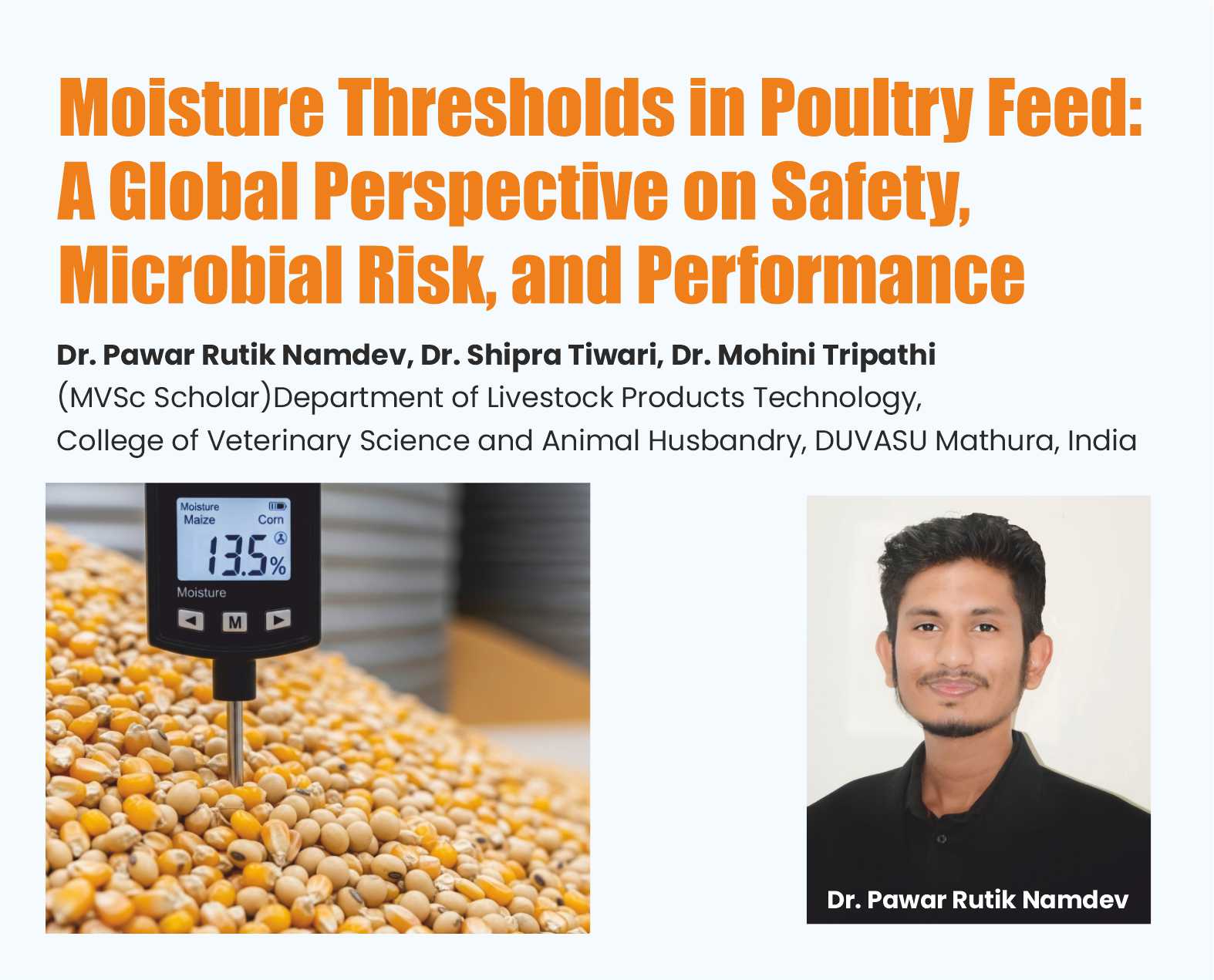
– Use moisture meters for rapid, on-site moisture assessments.
– Conduct periodic laboratory analyses to evaluate microbial load and mycotoxin presence.
– Apply Hazard Analysis and Critical Control Points (HACCP) principles during feed production and storage to systematically identify and control risks.
5. Regulatory and Safety Implications
Global feed safety standards emphasize moisture control as a critical control point (CCP) due to its role in preventing contamination and zoonotic disease transmission. Compliance with international regulations enhances food safety, promotes animal welfare, and improves market access. Key regulatory frameworks include:
– Good Manufacturing Practices (GMP+)
– ISO 22000 – Food Safety Management Systems
– CODEX Alimentarius Guidelines
– EU Feed Hygiene Regulation (EC No. 183/2005).
Adhering to these standards not only ensures compliance but also strengthens consumer confidence and supports export competitiveness in international poultry markets.
6. Conclusion
Effective moisture management in poultry feed is fundamental to ensuring feed hygiene, animal health, and overall food safety. Elevated moisture levels promote the growth of harmful microorganisms and the accumulation of toxic metabolites, leading to severe implications for poultry health, productivity, and farm economics.By adopting preventive strategies in feed production, storage, and quality monitoring, producers can safeguard feed integrity and protect flock performance. Moisture control should be recognized not as an operational expense but as a strategic investment in animal welfare, economic sustainability, and public health protection.