


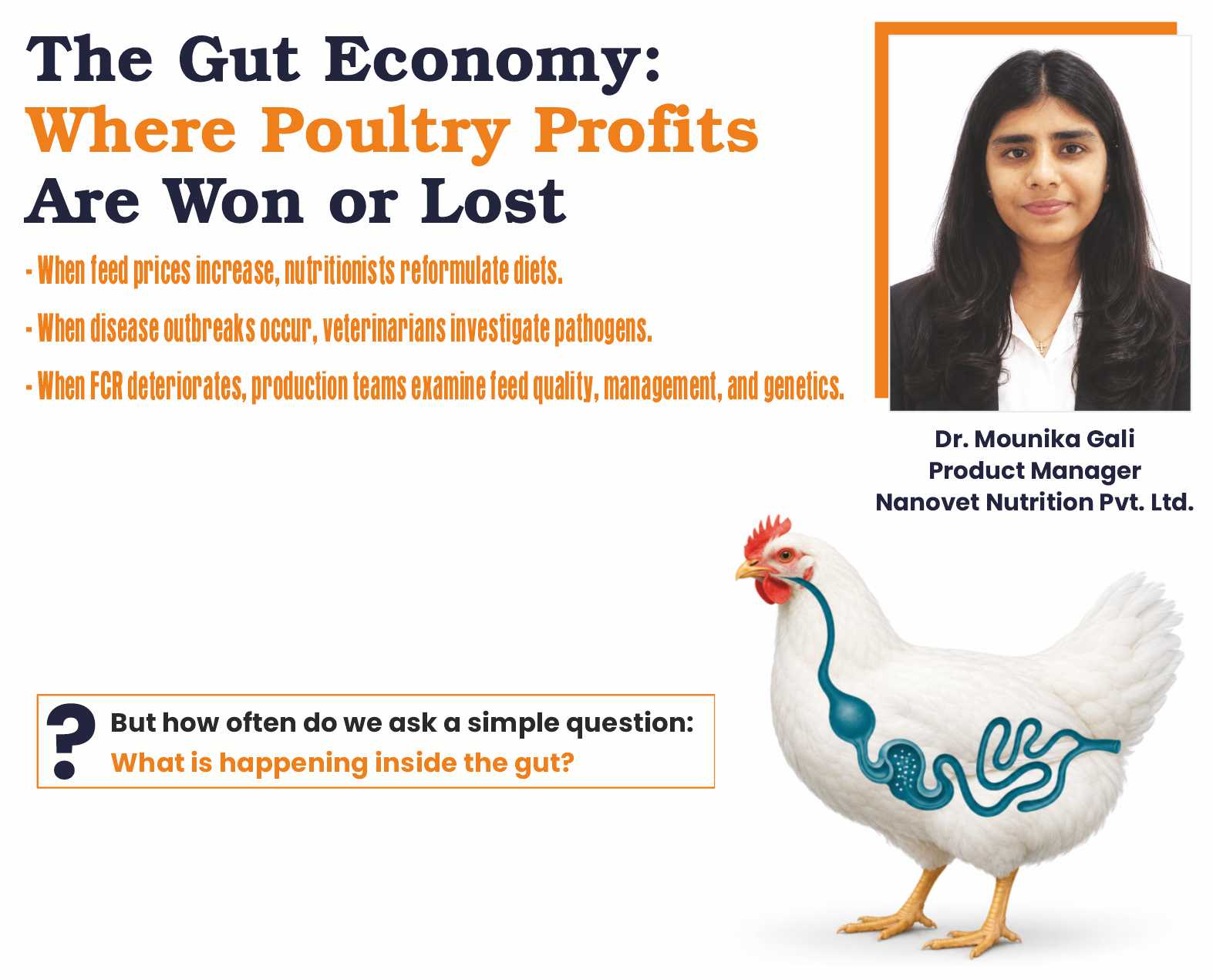
The poultry gut is arguably the most economically important organ in the bird. Yet its contribution to profitability is often underestimated because most of its battles are invisible.
Every day, a broiler’s intestine processes several times its body weight in feed and water, encounters billions of microorganisms, responds to environmental stress, and continuously decides what enters the body and what remains outside.
In many ways, the gut functions as a customs checkpoint, security system, digestive factory, and immune headquarters—all at the same time.
In fact, nearly 70% of the bird’s immune cells are associated with the gastrointestinal tract, making it a key player in both health and performance. The remarkable aspect is that when the gut is functioning well, nobody notices it. When it begins to fail, everybody notices the consequences.
The Modern Poultry Bird: Built for Speed
Today’s broiler is a biological marvel. Through decades of genetic selection, modern birds reach market weight faster and more efficiently than ever before.
However, this achievement comes with a hidden challenge.
The digestive tract has become one of the most critical performance-limiting organs in poultry production. Every gram of feed must be digested, absorbed, and converted into muscle within an increasingly compressed production cycle.
Twenty years ago, a small reduction in nutrient absorption might have gone unnoticed. Today, even minor intestinal inefficiencies can translate into measurable losses in body weight gain, feed conversion ratio, and profitability. Modern birds can no longer afford a lazy gut.
The Gut Is Constantly Making Decisions
Traditionally, we think of the intestine as a nutrient absorption organ.
In reality, the gut is making thousands of biological decisions every second.
– Should nutrients support growth or immunity?
– Should a microorganism be tolerated or eliminated?
– Should energy be invested in production or defense?
– Should the intestinal barrier remain open for absorption or tighten to prevent invasion?
These microscopic decisions ultimately determine flock performance.
In many ways, poultry production is not simply about feeding birds—it is about influencing the decisions being made within the gut.
The Hidden Cost of Inflammation
One of the most important concepts emerging in poultry science is that inflammation carries a nutritional cost.
Whenever the intestine encounters stress from pathogens, mycotoxins, heat, poor litter quality, or microbial imbalance, the immune system becomes activated.
The immune response is essential for survival, but it is expensive.
Energy that could support growth is redirected toward immune activity.
Amino acids that could build muscle are utilized to produce immune proteins and inflammatory mediators.
Vitamins and minerals become involved in tissue repair and antioxidant defense.
The bird continues eating, yet a significant proportion of nutrients may no longer be contributing to production.
This phenomenon is often referred to as the “hidden feed cost” of inflammation.
The Silent Performance Thief
One of the greatest misconceptions in poultry production is that intestinal problems always produce visible symptoms.
– Not necessarily.
– Many flocks show normal feed intake, acceptable mortality, and no obvious disease outbreaks. Yet they consistently fail to achieve target performance.
– A slight reduction in nutrient absorption.
– A minor microbial imbalance.
– A low level of intestinal inflammation.
– A subtle increase in intestinal permeability.
Individually these changes may appear insignificant. Collectively they can result in substantial economic losses. This is why gut health is increasingly viewed not as a disease issue but as a performance issue.
The Microbial Workforce Inside Every Bird
Perhaps the most fascinating discovery in recent years is the realization that birds are never truly alone.
The digestive tract contains trillions of microorganisms collectively known as the gut microbiome.
These microbes help digest feed ingredients, produce beneficial metabolites, support intestinal development, influence immune responses, and compete with harmful bacteria.
Some scientists now describe the microbiome as an additional organ because of its profound influence on bird health.
This raises an interesting question:
Are we feeding the bird, or are we feeding its microbiome?
The answer is both.
The future of poultry nutrition may depend as much on managing microbial populations as on balancing nutrients.
Heat Stress: The Gut’s Greatest Enemy
In many poultry-producing regions, heat stress has become one of the most significant challenges affecting gut health.
High environmental temperatures reduce blood flow to the intestine, increase oxidative stress, and compromise intestinal barrier integrity.
As a result, harmful bacterial toxins can cross the intestinal wall and trigger inflammation.
Often the first casualty of heat stress is not growth—it is gut integrity.
This may explain why heat-stressed flocks frequently show poorer FCR, increased wet litter, reduced nutrient utilization, and greater disease susceptibility.
As global temperatures continue to rise, protecting gut health during periods of heat stress will become increasingly important.
The Gut in the Antibiotic-Free Era
The poultry industry is rapidly transitioning toward antibiotic-free and reduced-antibiotic production systems.
While this shift addresses consumer concerns and regulatory requirements, it has also increased attention on intestinal health.
Without routine antibiotic growth promoters, producers must rely on alternative strategies to maintain gut stability.
Probiotics, prebiotics, β-glucans, mannan oligosaccharides (MOS), organic acids, phytogenic compounds, and postbiotics are increasingly being used to support intestinal resilience and microbial balance.
The focus is shifting from killing pathogens to creating an intestinal environment where beneficial microbes and the host can thrive together.
More Birds or More Protein?
The global poultry industry is not being asked to produce more birds.
It is being asked to produce more protein.
As the world’s population grows and consumers increasingly seek affordable animal protein, poultry production continues to expand. Industry projections estimate the sector will grow at a CAGR of approximately 5–7% over the coming years.
But growth alone is not enough.
Producers are expected to deliver more meat with fewer resources, lower feed costs, and a smaller environmental footprint.
This means that every gram of feed matters more than ever before.
And that brings us back to the gut.
Because the difference between feed consumed and protein produced is ultimately determined by the efficiency of the digestive system.
The Future Begins in the Gut
For decades, poultry production focused on genetics, nutrition, and disease control.
The next frontier may be intestinal resilience.
Future improvements in productivity will likely come from better management of inflammation, enhanced barrier integrity, optimized microbiomes, and improved nutrient efficiency within the gastrointestinal tract.
The question may no longer be:
“How much feed did the bird consume?”
Instead, the more important question may be:
“How much of that feed actually became growth?”
The answer lies within the gut.
Not because it is merely another organ, but because it is the organ that determines how effectively all the others perform.
In an era of narrow margins, rising feed costs, heat stress, and antibiotic-free production, the healthiest gut may ultimately become the most valuable asset in the poultry house.