



Abstract
The Indian poultry sector is a cornerstone of the nation’s livestock economy, ensuring nutritional security, livelihood opportunities, and rural empowerment. As India advances towards the vision of Viksit Bharat 2047, strengthening animal health through modern vaccination strategies becomes imperative. Poultry production faces persistent challenges from infectious diseases such as Newcastle Disease, Infectious Bursal Disease, Marek’s Disease, Avian Influenza, and Salmonellosis, which not only cause heavy economic losses but also threaten food safety and trade opportunities. While conventional vaccines have played a pivotal role in disease control, their limitations—such as cold chain dependence, maternal antibody interference, and inadequate protection against evolving strains—demand innovative solutions.
Next-generation vaccine technologies, including recombinant DNA vaccines, vector-based vaccines, immune-complex vaccines, thermostable formulations, and in-ovo delivery systems, are transforming poultry health management. These approaches offer enhanced safety, longer-lasting immunity, and the potential for multivalent protection. Thermostable vaccines and oral or feed-based delivery methods hold special promise for rural and smallholder farmers by overcoming infrastructural constraints. Moreover, advanced vaccines contribute significantly to antimicrobial stewardship by reducing dependence on antibiotics, thereby aligning with the global One Health agenda and mitigating antimicrobial resistance risks.
The pathway to widespread adoption of these technologies requires integrated efforts from policymakers, research institutions, and the private sector. Public-private partnerships, farmer training, and targeted extension services are essential to ensure affordability, accessibility, and farmer compliance. Furthermore, harmonization with international standards will open new avenues for Indian poultry exports.
Over all next-generation poultry vaccines represent more than a disease-prevention tool; they are strategic enablers of sustainable production, food security, and global competitiveness. By embedding these innovations into a national animal health roadmap, India can safeguard its poultry sector and accelerate progress towards the goals of Viksit Bharat.
Poultry Sector and National Vision
The Indian poultry sector has emerged as one of the fastest-growing components of the livestock economy, contributing significantly to nutritional security, rural livelihoods, and national income. With over 6 million tonnes of chicken meat and more than 142 billion eggs produced annually, India ranks among the top poultry producers globally. However, the vision of Viksit Bharat 2047 emphasizes not just growth in numbers, but also sustainability, biosecurity, and resilience against diseases. Poultry flocks face major health threats from viral, bacterial, and parasitic infections, which can severely disrupt productivity. Vaccination is the most cost-effective and scientifically proven method to prevent infectious diseases in poultry. It not only safeguards flock health but also reduces dependency on antibiotics, thereby aligning with global efforts to combat antimicrobial resistance (AMR). In the Indian context, a robust vaccination strategy combined with innovative vaccine technologies is essential to ensure safe, sustainable, and globally competitive poultry production.
Major Poultry Diseases and Need for Vaccination
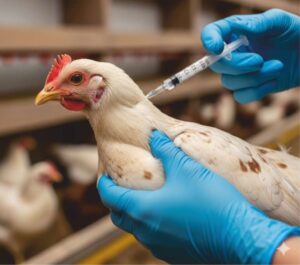
The Indian poultry industry is vulnerable to several devastating diseases that can wipe out entire flocks if not managed effectively. Newcastle Disease (Ranikhet), Infectious Bursal Disease (IBD or Gumboro), Marek’s Disease, Fowl Pox, Avian Influenza, Mycoplasmosis, Salmonellosis, and Coccidiosis remain primary threats. Outbreaks not only cause direct mortality but also result in poor feed conversion, reduced egg production, stunted growth, and increased veterinary costs. In a sector with narrow profit margins, even small disease outbreaks can push farmers into financial crisis. Vaccination is critical to prevent such losses and ensure predictable production. For example, ND vaccination is universally adopted in India, while IBD and Marek’s vaccines are routinely used in broiler and layer flocks. Vaccination also acts as a barrier against zoonotic diseases like Avian Influenza, which pose risks to human health. Beyond biological protection, vaccines are key to market access, as global trade standards demand disease-free certification. Thus, comprehensive vaccination programs serve as both a production necessity and a policy imperative for India’s poultry sector in its journey towards Viksit Bharat.
Current Vaccination Strategies in India
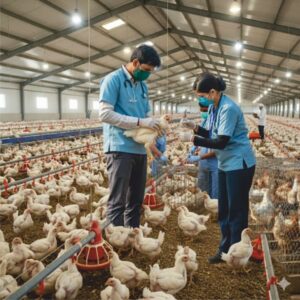 Presently, the Indian poultry industry relies on a mix of live attenuated, inactivated (killed), and recombinant vaccines. Day-old chicks are often vaccinated at hatcheries, while subsequent doses are administered at farms by trained personnel. Broilers typically receive vaccines against ND, IBD, and Marek’s, while layers undergo longer schedules covering Fowl Pox, Egg Drop Syndrome, and Salmonellosis. Commercial hatcheries have standardized protocols, but backyard and smallholder poultry systems still suffer from low vaccine coverage due to lack of access and awareness. Vaccines are usually delivered through drinking water, eye drops, intramuscular injections, or wing web methods. However, challenges persist in maintaining the cold chain, ensuring correct dosages, and preventing improper administration. Despite these limitations, vaccination coverage in commercial farms has improved significantly, leading to better flock health and reduced antibiotic dependence. Government agencies, private companies, and veterinary universities are working collaboratively to extend these benefits to rural poultry farmers. Standardized vaccination calendars tailored to regional disease prevalence can further improve efficiency. The existing strategies, though effective, need technological upgrades and equitable access to align with India’s aspirations of modern, climate-resilient, and globally integrated poultry production.
Limitations and Challenges of Conventional Vaccines
Despite their proven utility, conventional vaccines face several limitations in the Indian poultry sector. Live vaccines, while highly immunogenic, sometimes revert to virulence or interact with maternal antibodies, reducing their effectiveness. Inactivated vaccines, though safe, require multiple doses and are more expensive. In addition, improper handling—such as exposure to high temperatures during transportation—often compromises vaccine efficacy. A major challenge is the mismatch between circulating field strains and the strains used in commercial vaccines. For example, evolving variants of ND and IBD viruses occasionally bypass existing vaccines, causing outbreaks even in vaccinated flocks. Smallholder and backyard poultry, which form a substantial part of India’s rural economy, often remain unvaccinated due to cost, limited access, and lack of cold chain infrastructure. Moreover, conventional vaccines rarely provide sterilizing immunity, allowing vaccinated birds to shed pathogens silently, which complicates disease eradication efforts. In the backdrop of climate change, rising stocking densities, and globalization of poultry trade, these limitations demand next-generation vaccine solutions. To achieve Viksit Bharat, India must address these challenges by integrating science, technology, and farmer-centric delivery systems in its poultry vaccination programs.
Advances in New Vaccine Technologies
Recent scientific breakthroughs have paved the way for innovative vaccines tailored to modern poultry needs. Recombinant DNA vaccines, vector-based vaccines, immune-complex vaccines, and nanoparticle-based delivery systems are gaining traction. These technologies offer higher safety, broader protection, and longer-lasting immunity compared to traditional vaccines. For instance, recombinant vaccines can target multiple pathogens simultaneously, reducing the need for multiple injections. Immune-complex vaccines help overcome maternal antibody interference, ensuring early chick protection. Thermostable vaccines, currently being developed, can withstand higher temperatures, eliminating the need for stringent cold chains—a boon for rural and remote areas. Moreover, edible vaccines derived from transgenic plants and oral vaccines administered through feed or water provide farmer-friendly alternatives. The integration of nanotechnology has enhanced antigen stability and delivery, improving immune response. These innovations not only improve disease control but also align with sustainable and antibiotic-free poultry production systems. By adopting such advanced technologies, India can strengthen its poultry sector to withstand future disease challenges while ensuring affordability and accessibility for all categories of farmers.
Hatchery-Based and In-Ovo Vaccination
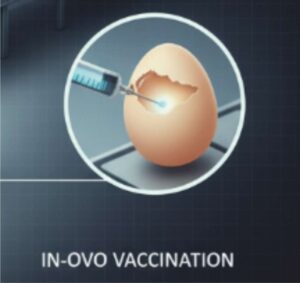
One of the most transformative innovations in poultry vaccination is hatchery-based immunization, particularly in-ovo vaccination. In this method, vaccines are delivered directly into the egg on the 18th day of incubation, before the chick hatches. This ensures early, uniform, and stress-free protection against diseases like Marek’s and ND. Automated in-ovo vaccination systems allow high-throughput immunization with minimal labour, ensuring biosecurity and accuracy. Post-hatch, chicks already possess robust immunity, reducing the risk of early chick mortality. This approach also minimizes handling stress, improving welfare and productivity. For commercial hatcheries in India, in-ovo vaccination holds immense promise in terms of scalability, cost-effectiveness, and alignment with global best practices. Hatchery vaccination of day-old chicks against ND, IBD, and Salmonella is already gaining popularity. As India modernizes its hatchery infrastructure under the Viksit Bharat framework, the integration of in-ovo technologies can revolutionize poultry health management. Expanding these practices to both commercial and rural hatcheries will ensure equitable benefits across the value chain. Thus, hatchery-based vaccination strategies represent a forward-looking step towards resilient poultry farming.
Role in Antibiotic Stewardship and AMR Reduction
The overuse of antibiotics in poultry has been a long-standing concern due to its contribution to antimicrobial resistance (AMR), which poses a global public health threat. Vaccination is a powerful tool in reducing reliance on antibiotics by preventing bacterial infections and associated secondary complications.
For example, vaccines against Salmonella, E. coli, and Mycoplasma significantly reduce the need for antibiotic treatments. In addition, viral vaccines indirectly lower antibiotic usage by reducing co-infections that would otherwise require antimicrobial intervention. India’s poultry sector is under increasing scrutiny from consumers, exporters, and regulators regarding antibiotic residues in meat and eggs. By adopting comprehensive vaccination programs and new-generation vaccines, the industry can move towards antibiotic-free poultry production systems, aligning with international standards. This is particularly crucial as India eyes larger export markets in the Middle East, Africa, and Asia-Pacific. Vaccination-led AMR stewardship is not just a health necessity but also a trade enabler and consumer confidence booster. Thus, vaccines play a pivotal role in aligning India’s poultry industry with the One Health approach and the national goal of Viksit Bharat.
Policy Support and Public-Private Partnerships
The success of vaccination strategies in India depends heavily on supportive policies, infrastructure, and partnerships. Government agencies like the Department of Animal Husbandry, ICAR institutes, and State Veterinary Departments must play a central role in disease surveillance, vaccine research, and farmer training. At the same time, private vaccine manufacturers, integrators, and farmer cooperatives need to collaborate in creating affordable and farmer-friendly solutions. Public-private partnerships (PPP) can accelerate the development of thermostable vaccines, indigenous recombinant vaccines, and scalable hatchery vaccination systems. Subsidies, credit support, and extension services should be provided to smallholder farmers to improve vaccine adoption. Strengthening diagnostic laboratories and surveillance networks will ensure vaccines are updated against circulating strains. Furthermore, India must harmonize its poultry vaccination policies with WOAH (World Organisation for Animal Health) and Codex standards to expand exports. By embedding vaccination strategies into national livestock and poultry development programs, policymakers can ensure that poultry contributes robustly to the nutritional, economic, and employment goals envisioned under Viksit Bharat.
Capacity Building and Farmer Awareness
A robust vaccination strategy is incomplete without farmer participation and awareness. Many disease outbreaks in India are linked to gaps in farmer knowledge about vaccine handling, schedules, and post-vaccination management. Training programs, mobile-based advisory services, and community-based poultry health workers can play an important role in bridging these gaps. Integrating digital tools like AI-driven vaccination calendars, blockchain-based cold chain monitoring, and mobile reminders can improve efficiency and compliance. Educational campaigns in local languages are needed to dispel myths about vaccination, such as misconceptions regarding reduced fertility or productivity. Special emphasis must be placed on women farmers, who play a crucial role in backyard poultry rearing but often lack access to formal veterinary training. Farmer cooperatives, SHGs (Self Help Groups), and FPOs (Farmer Producer Organizations) can act as vehicles for disseminating vaccination services at the grassroots. By building capacity and creating farmer-centric vaccination systems, India can democratize the benefits of new vaccine technologies, ensuring inclusive growth of the poultry sector.
Vaccination Roadmap towards Viksit Bharat
The future of India’s poultry sector lies in its ability to combine productivity with sustainability, resilience, and global competitiveness. Vaccination strategies and new vaccine technologies form the cornerstone of this transformation. From conventional vaccines to recombinant DNA vaccines, in-ovo immunization, thermostable formulations, and nanotechnology-driven innovations, the spectrum of tools available today is wider than ever. However, technology alone is not enough. Equitable access, policy support, capacity building, and farmer participation are equally vital. A national poultry vaccination roadmap aligned with Viksit Bharat 2047 should prioritize:
(I) strengthening surveillance and diagnostics,
(ii) promoting indigenous vaccine R&D,
(iii) scaling hatchery-based immunization,
(iv) supporting smallholder vaccination access, and
(v) integrating vaccination with AMR stewardship.
By embracing these strategies, India can ensure that its poultry sector not only meets the rising domestic demand for safe, affordable protein but also positions itself as a global leader in sustainable poultry production. Vaccination is more than just a disease-control measure; it is a strategic investment in the nation’s food security, public health, and economic prosperity.