

Dr. Nilay Deshpande1, Dr. Vishal Patil2 and Dr. Geeta Pipaliya3
1PhD Poultry Science, 2MVSc Poultry Science, ICAR-Directorate of Poultry Research, Hyderabad
3Scientist, ICAR-Central Avian Research Institute, Izatnagar
Introduction
Insoluble fiber has gained increasing recognition in modern poultry nutrition due to its physiological importance, impact on digestive health, nutrient utilization, and welfare outcomes in birds. Unlike soluble fiber, which is rapidly fermented and increases digesta viscosity, insoluble fiber adds bulk, optimizes intestinal motility, and influences digesta structure to facilitate more efficient nutrient digestion and absorption.
Composition and Characteristics
Insoluble fiber primarily consists of cellulose, hemicellulose, and lignin—structural plant components resistant to hydrolysis by poultry endogenous enzymes. As it passes largely intact through the gastrointestinal tract (GIT), its physiological effects are exerted mainly through physical stimulation of digestive processes and organs rather than fermentation.
 Mechanisms of Action
The activity of insoluble fiber in poultry nutrition is mediated through multiple mechanisms. Due to its indigestible nature, insoluble fiber accumulates in the gizzard, enhancing muscular development and function, thereby facilitating mechanical feed breakdown and improved efficiency of nutrient digestion. Moderate inclusion levels (1–2%) accelerate digesta passage, reduce retention of toxic metabolites, and enhance intestinal health. Insoluble fiber stimulates secretions of amylase, lipase, and protease, thereby improving starch, protein, and fat digestibility. Inclusion supports favorable intestinal morphology, such as increased villus height and crypt depth, contributing to enhanced absorptive capacity. Microbial Modulation: Insoluble fiber fosters a balanced gut microbiota by modifying the luminal environment and limiting pathogen proliferation.
Physiological and Welfare Outcomes
The presence of insoluble fiber in poultry diets exerts several measurable outcomes:
– Enhanced gizzard and proventriculus growth, supporting feed utilization efficiency.
– Faster intestinal transit, minimizing toxin accumulation.
– Improved litter quality and reduced wet litter incidence.
– Behavioral benefits, including amelioration of cannibalism and improved satiety, particularly in layers.
Metabolic Effects and Excretion
Metabolically, insoluble fiber is minimally fermented in the caeca, with its primary influence derived from physical and physiological stimulation. Notable outcomes include:
– Enhanced pancreatic enzyme secretion, improving nutrient extraction.
– Improved intestinal morphology that augments nutrient absorption.
– Increased bulk volume of excreta with improved consistency, resulting in firmer, drier droppings.
– Reduced ammonia generation and improved hygiene, thereby lowering infection risks in poultry houses.
Sources of Insoluble Fiber
Historically, wheat bran and rice bran have been common fiber sources due to their high cellulose content and cost-effectiveness. However, their susceptibility to mycotoxin contamination has prompted a transition to safer alternatives:
– Agricultural By-products: Oat hulls, soybean hulls, sunflower hulls, and pea hulls now serve as reliable fiber sources with high inclusion potential.
– Purified Products: Commercial lignocellulose concentrates provide mycotoxin-free, standardized fiber inclusion with improved reliability.
– Other Sources: Rice hulls and wood shavings add bulk, contributing positively to litter quality, nutrient absorption, and predator-prevention behavior (e.g., reduced cannibalism).
Comparative Nutritional Profiles
Wheat and rice bran remain cost-effective and commonplace, though often limited to below 5% of the diet because of contamination risks. Soybean and sunflower hulls offer high crude fiber and moderate protein, while oat hulls excel in stimulating digestive organs. Lignocellulose offers the highest concentration of insoluble fiber with the lowest contamination risk and greatest consistency.
Performance Outcomes
Recent Indian studies (2024) demonstrated that the inclusion of 2.5% soybean hulls or lignocellulose in broiler diets improved body weight gain (BWG) and feed conversion ratio (FCR). Similarly, rice hull supplementation has been associated with increased gizzard weight without adverse effects on carcass yield, validating the importance of insoluble fiber for digestive organ development and growth performance.
Strategies to Manage Soluble and Insoluble Fiber Levels
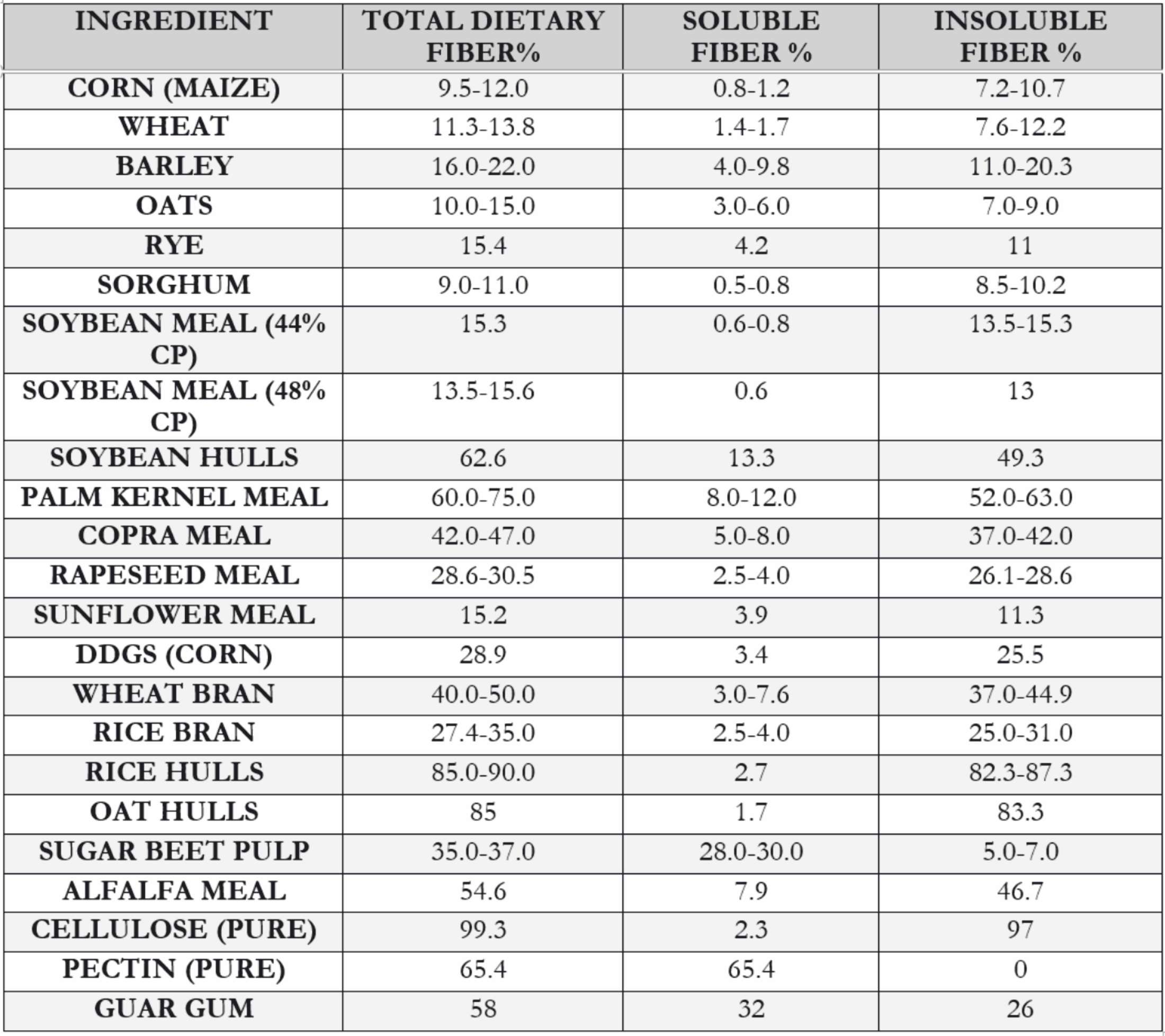
The key to successful fiber management lies in achieving optimal ratios. Research demonstrates that moderate levels of insoluble fiber (3-5% of diet) can actually enhance nutrient digestibility by stimulating digestive organ development and pancreatic enzyme secretions, while excessive soluble fiber levels create viscosity problems that impair performance.
1) Cost-Effective Fiber Source Selection
Primary Insoluble Fiber Sources
Wheat bran remains the most economical insoluble fiber source, providing 44.6 % fiber content. It offers excellent laxative properties when mashed with warm water and helps maintain optimal litter moisture.
Rice bran represents another cost-effective option, delivering 10-14% protein alongside 20-24% total dietary fiber and 10.4 MJ ME/kg energy content. This dual nutrient contribution makes rice bran particularly valuable for achieving both fiber and protein targets.
De-oiled rice bran (DORB) provides concentrated fiber benefits with reduced oil content, making it suitable for higher inclusion rates without compromising pellet quality.
Alternative Fiber Sources
Sunflower hulls and oat hulls offer concentrated insoluble fiber sources that require minimal inclusion levels to achieve desired fiber targets. These sources are particularly valuable when formulating high-energy density diets where traditional bran sources would excessively dilute nutrient concentration.
Soy hulls contain approximately 36% crude fiber and 10% crude protein, making them excellent fiber sources for ruminants but requiring careful consideration in poultry diets due to potential bloating risks.
2) Enzyme-Based Fiber Management Strategies
Single Enzyme Approaches
Xylanase supplementation at 16,000-32,000 BXU/kg has proven highly effective for managing arabinoxylans, particularly in wheat-based diets.
Research demonstrates that double-dose xylanase (32,000 BXU/kg) provides superior NSP degradation and oligosaccharide release compared to standard doses.
Studies with de-oiled rice bran supplementation show that xylanase at 10g/100kg feed improved body weight gain and feed consumption while reducing mortality rates compared to high-fiber control diets. The enzyme enabled profitable utilization of 4.5% crude fiber levels, with net profit per kg body weight gain being highest in the maximum fiber plus xylanase treatment.
Multi-Enzyme Complex Systems
Carbohydrase-protease-phytase combinations demonstrate additive beneficial effects, particularly in nutritionally marginal diets. Combined enzyme supplementation can improve body weight gain by 14% compared to individual enzyme use (6-7% improvement). This synergistic effect results from:
– Enhanced protein and amino acid digestibility through protease action
– Improved phosphorus availability via phytase activity
– Better carbohydrate utilization through NSP-degrading enzymes
– Reduced anti-nutritional factor impacts
NSP-degrading enzyme cocktails containing xylanase, β-glucanase, cellulase, pectinase, mannanase, galactanase, and arabinofuranosidase show variable results depending on substrate composition. While effective for complex fiber matrices, they require precise matching to dietary NSP profiles for optimal performance.
3) Feed Formulation Strategies for Cost Reduction
Matrix Value Application
Enzyme supplementation enables matrix value attribution, allowing nutritionists to reduce expensive ingredients while maintaining performance. Effective enzyme programs can provide energy matrices of 100+ kcal/kg, enabling significant reformulation flexibility.
Precision Nutrition Approaches and Fiber Level Management
Daily nutrient blending using a two-concentrate system, where a high-protein starter concentrate is diluted with a high-energy finisher concentrate, can improve feed conversion ratio by 7.8% while reducing feed costs by 4.13%. During the starter phase (0–10 days), diets should include minimal fiber (2–3% crude fiber) to maximize nutrient density and digestibility for critical early growth. In the grower phase (11–24 days), moderate fiber levels (3–4% crude fiber) combined with enzyme supplementation support gastrointestinal development while sustaining optimal growth performance. By the finisher phase (25+ days), strategic fiber inclusion at 4–5% helps reduce feed costs while promoting gut health and desirable meat quality parameters.
Advantages and Limitations
Insoluble fiber supplementation improves gut health by stimulating gizzard development, promoting intestinal morphology, and enhancing growth of beneficial microflora without adverse increases in digesta viscosity. It also provides measurable behavioural and welfare benefits—reducing cannibalism and supporting satiety in laying hens. By improving excreta consistency, insoluble fiber minimizes moisture, ammonia emissions, and infection risks. From a sustainability standpoint, utilizing agricultural by-products such as hulls and bran helps recycle waste and reduce environmental impact.
However, excessive use of insoluble fiber can dilute nutrient density, potentially impairing bird performance and necessitating careful dietary balancing. Variability in natural fiber sources—regarding composition, particle size, and quality—poses challenges for consistent feed formulation unless standardized products are used. Traditional sources such as wheat bran carry substantial mycotoxin risks; coarse materials can also complicate feed processing and flow. Moreover, insoluble fiber is poorly fermented, not contributing to beneficial short-chain fatty acid production observed with soluble fiber inclusion.
Market Trends and Future Perspectives
The global high-fiber feed market is projected to expand at a CAGR of approximately 6% through 2033, driven by rising consumer demand for welfare-centric, antibiotic-free poultry production. Current trends emphasize: Adoption of precision nutrition and stage-specific fiber blends. Expanded use of purified, standardized lignocellulose as a safe alternative to brans. Integration of fiber with probiotics and enzymes for optimized synergistic effects. Alignment with circular economy goals by valorizing crop by-products for feed.
Conclusion
Insoluble fiber, though metabolically inert, plays a fundamental physiological and metabolic role in poultry nutrition. Its inclusion enhances digestive efficiency, improves nutrient utilization, promotes gut health, optimizes excretion, and contributes to sustainable and welfare-friendly production systems. With ongoing innovations in fiber processing and precision feeding strategies, insoluble fiber presents substantial opportunities to improve poultry performance and farm sustainability. Proper management of inclusion rates and strict quality control remain critical for maximizing its benefits.
References are available on request.