
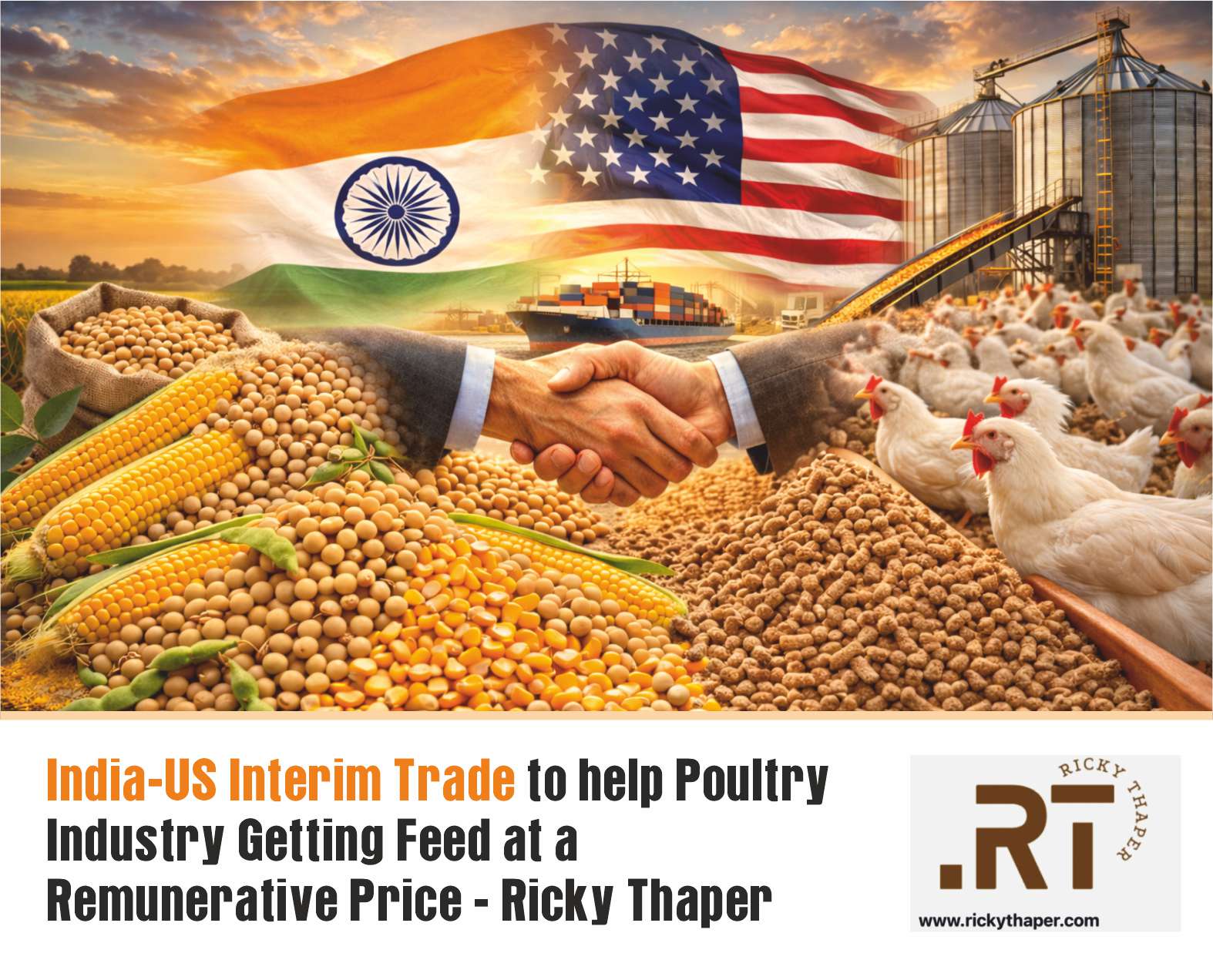

India-US Interim Trade to help Poultry Industry Getting Feed at a Remunerative Price – Ricky Thaper
Importance of Livestock and Poultry Sector in India
India’s livestock sector plays a crucial role in the country’s agricultural and economic landscape, supporting the livelihoods of millions by providing employment, income and nutritional security. Poultry and livestock sector provides essential inputs for sustainable farming practices, ensuring the country’s food security. India’s poultry industry is currently valued at $ 30 billion which engages over six million people (both directly as well indirectly) and the poultry industry has grown rapidly over the past decade. Indian poultry industry is now one of the most efficient producers of broiler meat and eggs globally, due to well established integrated companies, contract farming and a strong domestic market.
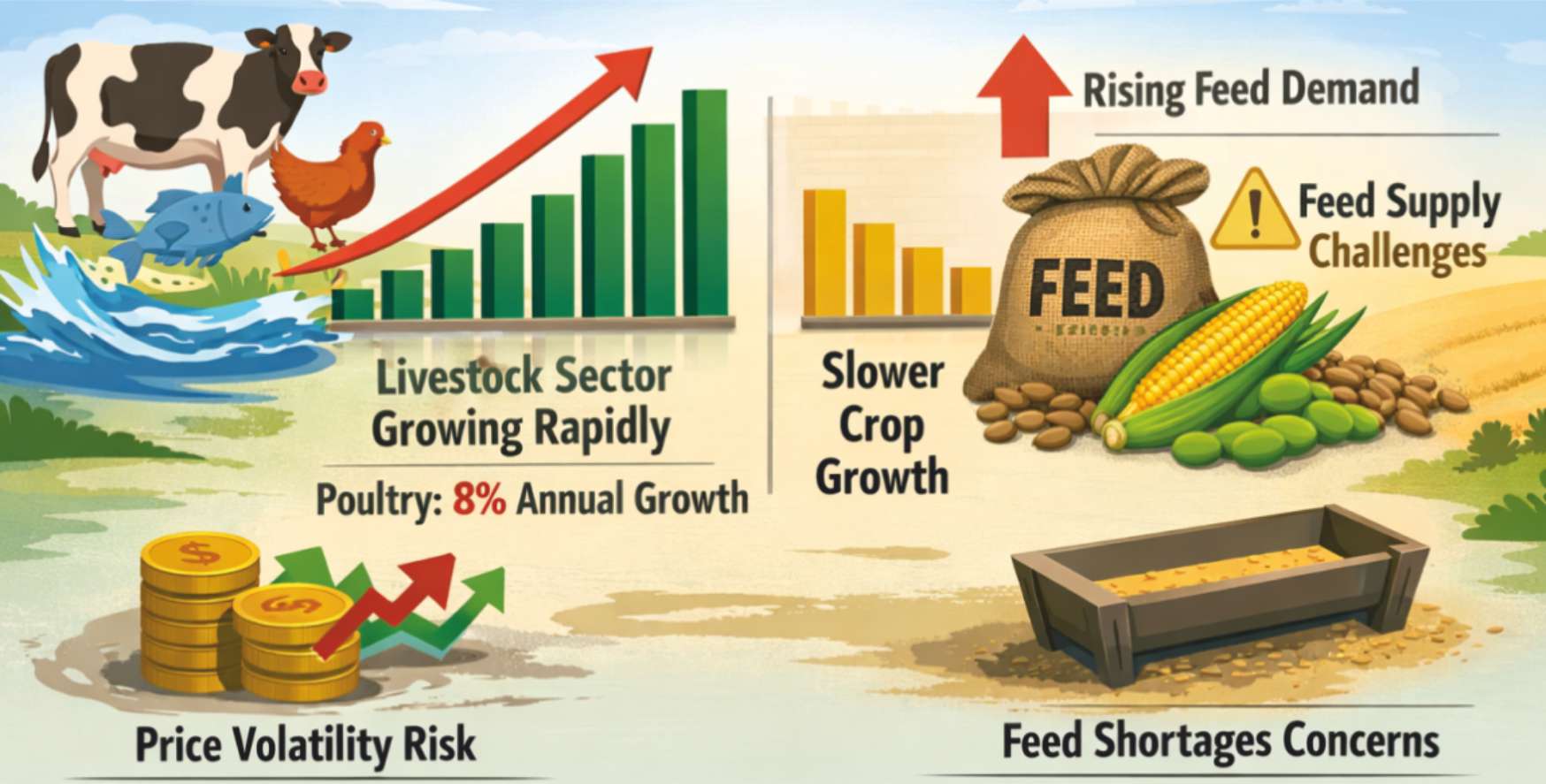
Rising Growth and Feed Demand Imbalance
The livestock sector – dairy, poultry, fisheries and allied sector is witnessing a much faster growth than the agriculture crops (Soybeans & Maize), there is apprehension that domestic feed production may not be able to ensure steady supplies while exposing the sector to price volatility. The Confederation of Indian Industry (CII) in its vision document 2047 for the Indian poultry sector has also mentioned that the sector is growing at a healthy rate of 8% annually and could see further acceleration. Availability of good quality feed ingredients and their prices are major challenges for manufacturing of good quality compound feeds.
Role of India–US Interim Trade Agreement
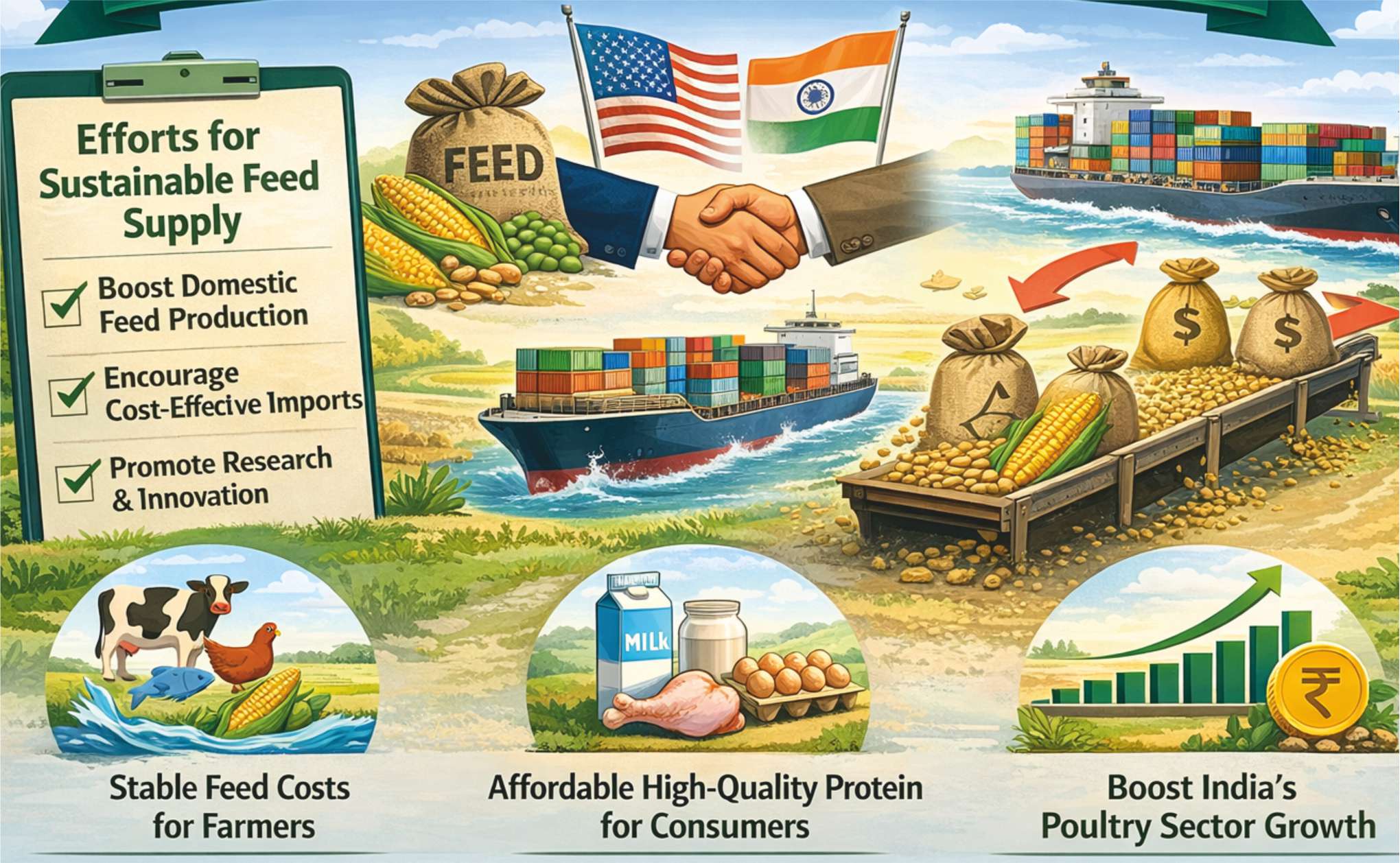
Under the recently announced India-US interim-trade, the decision to eliminate or cut duties on a range of items from the US including dried distillers’ grains (DDGs) and red sorghum, is likely to ensure steady supplies of animal feed in coming years. Commerce minister Piyush Goyal had stated that India will provide quota-based duty concessions on DDGs to the US under the deal. Feed demand is projected to grow faster than domestic supply, making large scale imports necessary by the early 2030s. Domestic production of energy sources like maize and protein sources like soymeal often fall short of growing demand of the poultry, dairy and fisheries sector.
Feed Cost Pressure and Need for Imports
Domestic feed supply is increasingly constrained by limited arable land and productivity gaps. The feed costs constitute 60% to 65% of the cost of the production of the animal husbandry sector any volatility in the feed prices lead to rise in cost of production and subsequent rise in prices. Thus, feed imports, especially of reduced or zero duty imports of soybeans / soybean meal and maize, can help bridge the demand-supply gap. Imports from established origins such as US soy can provide consistent, high-quality protein during periods of domestic tightness. When used judiciously, imported soy can help smooth feed costs, improve formulation consistency, and enable feed manufacturers to meet the quality benchmarks demanded by large integrators and processors.
Growing Demand for Protein and Feed
With increase in income and urbanisation as demand for dairy and poultry products increases, according the United States Department of Agriculture (USDA) in its report titled ‘The Growing Demand for Animal Products and Feed in India’ has stated that at the current growth in the productivity of maize and soybean, would not be able to meet rising demand of feed. Feed demand is projected to grow faster than domestic supply, making large scale imports necessary by the early 2030s. “By ensuring a timely and cost-effective supply of these essential feed ingredients, the government is directly addressing the challenge of feed inflation. This will not only stabilise production costs for farmers but also ensure that high-quality protein remains affordable,”
Industry Concerns Over Feed Availability
Several National and State level Poultry Associations in a recent communication to Shri Rajiv Ranjan Singh, Union Minister of Animal Husbandry, Dairying and Fisheries, Government of India, has raised concern about availability and rising price of soybean meal in the country which pose risk to poultry production. The sector fears a crisis, which can severely affect livestock production and consumer prices. With nearly seven months until the next harvest of domestic soybean products, sustaining poultry production at viable cost will be difficult, directly impacting egg and chicken prices and overall inflation. Even maize prices have witnessed volatility as demand for the grain is rising not only because of rise in animal feed demand but also its being used for making ethanol and other industrial use.
Future Demand Projections (2047 Vision)
India’s population is around 1.4 billion and is projected to be approximately 1.53 billion by 2047. This increase in population directly correlates with the higher demand for food including eggs and chicken. Per capita poultry meat and eggs are expected to be 15 kg and 200 eggs annually by 2047. Around 38 million tonne (MT) of broiler feed and 34 MT of layer feed will be required in 2047. At 30% penetration rate, cattle feed requirement will be around 90 MT in 2047. Fish and shrimp feed required will be around 7 MT in 2047.
Way Forward: Ensuring Sustainable Feed Supply
Ensuring sustainable feed supplies in coming years would be a key challenge for the sector. By ensuring cost-effective supply of animal feed ingredients, the government can directly address the challenge of feed inflation. This will not only stabilize production costs for poultry, dairy and aqua farmers but shall also ensure that high-quality protein remains affordable for the consumers. The interim deal with the US provides a window of opportunity for allowing feed ingredients imports which is expected to boost the sustainable growth of the India’s poultry sector in the coming years.