

Abstract
Effective chiller sanitation is critical in poultry processing to minimize microbial contamination, preserve product quality, and maintain equipment integrity. This study evaluated the comparative performance of Intra Hydrocare, a chelated silver-stabilized hydrogen peroxide formulation, and sodium hypochlorite (NaOCl) at 50 ppm in screw chillers of a commercial poultry processing plant in Punjab, India. Over a two-month field trial, weekly samples (n = 12/event) were collected from chiller inlet water, outlet water, surfaces, and carcass rinses. Microbial load was assessed using Total Plate Count (TPC) and ATP bioluminescence, while equipment hygiene, sensory quality, and operator safety were also evaluated. Intra Hydrocare demonstrated consistently superior antimicrobial performance, maintaining >99.9% microbial reduction throughout the chilling cycle, compared with the rapid efficacy decay observed with NaOCl (≈50% loss by outlet). Biofilm disruption was markedly improved with Intra Hydrocare, reflected by an 85% reduction in ATP values. Chillers treated with NaOCl showed scaling and surface dulling, whereas Intra Hydrocare prevented corrosion, removed existing deposits, and supported improved hygiene. Sensory evaluation confirmed that Intra Hydrocare preserved product colour, odour, and texture, while NaOCl occasionally produced chlorinous odours and bleaching. Operator observations also indicated reduced eye irritation and improved handling safety with Intra Hydrocare. These findings highlight Intra Hydrocare as a highly effective, residue-free, and sustainable alternative to hypochlorite-based disinfectants in poultry screw chillers. Its adoption can enhance food safety, extend equipment lifespan, support certification compliance, and elevate overall processing efficiency.Keywords: Intra Hydrocare; Sodium hypochlorite; Poultry processing; Screw chillers; Hydrogen peroxide; Biofilm control; Microbial reduction; Total Plate Count (TPC); Equipment hygiene; Food safety.
Introduction
Effective sanitation in poultry processing plants is essential to minimize microbial contamination and ensure the safety and quality of final products. Screw chillers, which are critical for rapidly reducing carcass temperature following evisceration, represent a high-risk point for cross-contamination due to continuous exposure to organic matter, water recirculation, and contact between carcasses (Buncic & Sofos, 2012). Pathogens such as Salmonella spp. and Campylobacter spp. are frequently introduced into chiller systems and can persist on equipment surfaces or within biofilms, posing a significant public health risk and contributing to foodborne illnesses globally (EFSA, 2024; Scallan et al., 2011).
Sodium hypochlorite (NaOCl) remains one of the most widely used disinfectants in poultry chillers due to its broad-spectrum antimicrobial activity and low cost (Kim et al., 2023). In commercial processing, NaOCl is typically applied at concentrations around 50 ppm (Na et al., 2023) However, its performance is constrained by several operational and chemical limitations. First, chlorine activity is highly pH-dependent, with optimal performance in acidic environments (pH <7), whereas chiller systems often operate under neutral to slightly alkaline conditions, reducing biocidal efficacy (Amiri et al, 2010). Second, NaOCl reacts rapidly with organic matter, such as blood, fat, and proteins, leading to immediate depletion of free available chlorine and requiring repeated dosing to maintain effective concentrations (Waters and Hung, 2014). Third, sodium hypochlorite shows limited penetration into complex biofilms, which enables survival of Campylobacter, Listeria, and Salmonella on chiller surfaces despite routine sanitation (Alvarez-Ordóñez et al., 2019). Lastly, excessive dosing used to compensate for chlorine loss can negatively affect product quality, producing chlorinous off-odours, yellow discoloration, and bitterness, contributing to rejection rates of 15–20% in high-throughput processing plants (Agnello et al.,2012; Hurlbut et al.,1983; Gretchen Marlene Nagel, 2012; Kumar et al.,2023)
These limitations have prompted interest in alternative biocides that can maintain stability in organic-rich environments, exert broad antimicrobial action, avoid product quality deterioration, and improve worker safety. Intra Hydrocare, an ultra-stabilized hydrogen peroxide formulation, has gained recognition as a next-generation disinfectant. It is approved by the European Chemicals Agency (ECHA) under the Biocidal Products Regulation (BPR) for PT02, PT03, PT04, and PT05 applications, and holds NSF/ANSI Standard 60 certification for potable water systems. As a residue-free oxidizing biocide that decomposes into water and oxygen, Intra Hydrocare offers advantages including non-corrosiveness, extended shelf life, and suitability for organic production systems (USDA NOP; EU Organic Regulation 2018/848). Hydrogen peroxide-based disinfectants have demonstrated superior biofilm degradation, greater stability in organic environments, and reduced risk of sensory changes in treated poultry products (Stearns et al., 2022).
Given these properties, Intra Hydrocare presents a promising alternative to NaOCl in poultry chillers. The present study compares the performance of Intra Hydrocare and NaOCl under commercial processing conditions, with an emphasis on microbial reduction (total plate count, TPC), equipment hygiene, operator safety, and downstream product quality outcomes. The findings aim to inform evidence-based selection of sanitizing agents for modern poultry processing systems.
Materials and Methods
Study Period and Setting: The study was conducted from September 2025 to November 2025 at Perfect Poultry Products Pvt. Ltd., Amritsar, Punjab, India, a mid-scale commercial poultry processing plant (CPP) with a capacity of 30,000 birds/day. The facility operates four stainless-steel screw chillers of two sizes (2.1 m × 6 m and 1.6 m × 6 m), with capacities of 12,000 L and 8,500 L, respectively (Figure 1).
Study Design: A controlled, comparative field trial was implemented over a 2-month period. The four screw chillers were divided into two treatment groups:
1. Control group: Sodium Hypochlorite (NaOCl)
a) Two screw chillers operated using 50 ppm sodium hypochlorite (from commercial 10% NaOCl solution).
b) Dosing was performed via inline injection calibrated to maintain consistent free chlorine levels.
c) Water pH was monitored at each sampling (target: 7.2–7.5).
d) Free available chlorine was measured using chlorine indicator strips.
2. Trial group: Intra Hydrocare
a) Two screw chillers operated with 50 ppm Intra Hydrocare (ultra-stabilized hydrogen peroxide formulation).
b) The solution was dosed using a Dosatron venturi injector (dilution ratio 1:256) to ensure precise flow-proportional dosing.
c) Hydrogen peroxide concentration in the chiller water was verified using validated H2O2 test strips.
All chillers operated under identical process conditions. Carcasses underwent post-evisceration chilling for 55 minutes at 4°C (corrected from the earlier 45-minute estimate).
Sampling strategy: Sampling was performed weekly, generating 12 sampling events per chiller group over the study period. Samples were collected from:
a) Chiller inlet water
b) Chiller outlet water
c) Chiller surfaces (food-contact and non-contact)
d) Carcasses (post-chill rinse samples)
All sampling followed ISO/HACCP-aligned aseptic procedures.
Microbiological and Hygiene Assessments
1. Total Plate Count (TPC)
a) Swab samples from chiller surfaces and water were plated on Plate Count Agar (PCA).
b) Incubation: 30°C for 48 hours.
c) Carcass microbial loads were enumerated using the ISO 4833 standard rinse-and-plate method.
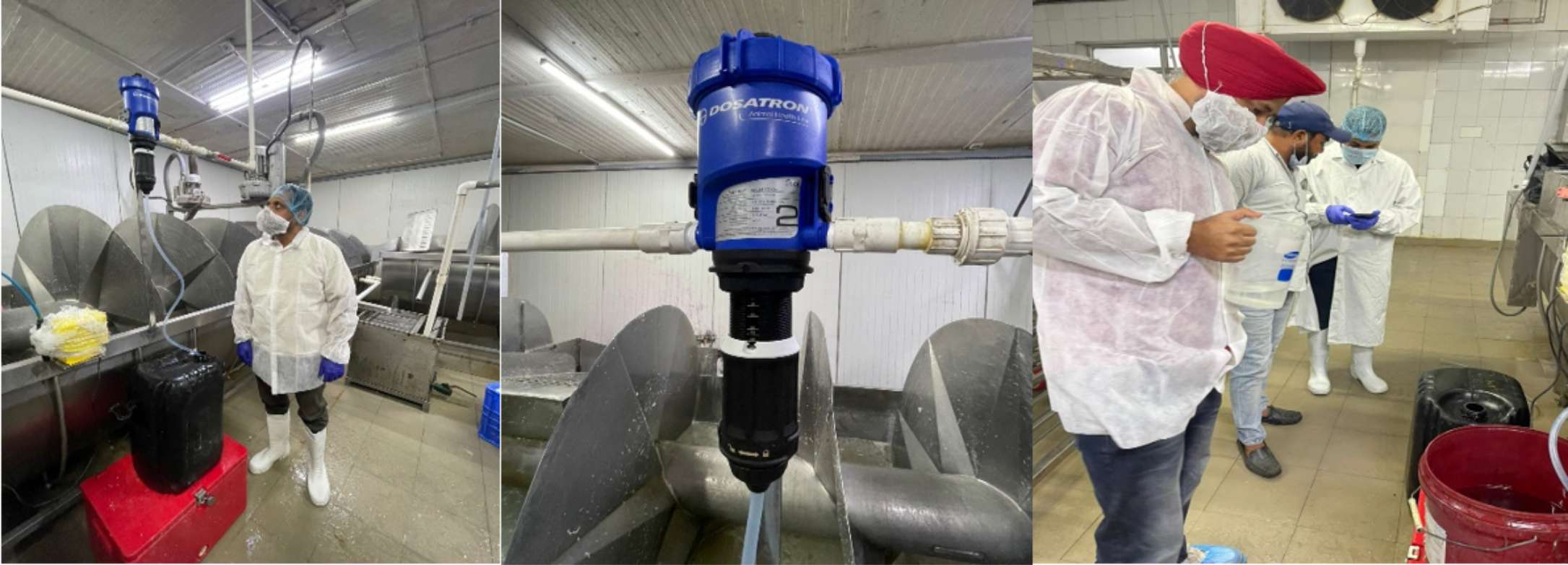
Figure 1: Representative pictures of the sampling sites
2. Biofilm assessment: Biofilm presence and surface hygiene were evaluated using ATP bioluminescence (Merck MVP ICON system), reported as relative light units (RLU). High RLU values indicated persistent organic load or biofilm activity.
Product Quality and Sensory Evaluation
1. Sensory attributes: A trained internal panel evaluated carcasses for colour, odour and taste, surface appearance. NaOCl-related off-odours, chlorinous notes, or bleaching were noted when present.
2. Chemical residue assessment: Chicken samples were screened for detectable oxidant residues at the end of the chilling process to compare:
– Chlorine residuals (NaOCl group)
– H2O2 residual absence (expected for Intra Hydrocare, decomposing into water + oxygen)
Operator safety assessment: Observations were recorded regarding operator comfort, PPE compliance, and chemical exposure effects.
– NaOCl exposure frequently caused eye irritation, bleaching of clothing, and harsh odour.
– Intra Hydrocare demonstrated no irritation, no corrosive effects, and better operator acceptability, although standard PPE was maintained as per plant protocols.
Compliance and ethical considerations: All activities adhered to established HACCP, Good Manufacturing Practices (GMP), and routine plant safety protocols. No pathogen-specific testing (e.g., Salmonella, Campylobacter) was undertaken as the focus was on indicator microbial load, hygiene markers, and operational performance.
Results
The comparative evaluation demonstrated that Intra Hydrocare consistently outperformed sodium hypochlorite (NaOCl) across all assessed parameters, including microbial reduction, biofilm control, product quality preservation, and equipment hygiene. A summary of the major findings is presented below.
1. Microbial efficacy
Intra Hydrocare showed substantially superior microbial control in both chiller water and carcass rinses. While NaOCl produced an initial drop in microbial load, its efficacy diminished rapidly as water moved through the chiller system, with approximately 50% loss in free chlorine activity by the outlet point. This decline corresponded with higher Total Plate Count (TPC) values at the outlet.
In contrast, Intra Hydrocare maintained stable activity throughout the chilling cycle, resulting in >99.9% overall log reduction across sampling points. ATP bioluminescence measurements further confirmed enhanced sanitation performance, with an 85% reduction in ATP, indicating strong biofilm disruption.
Table 1. Total Plate Count (TPC) in screw chillers
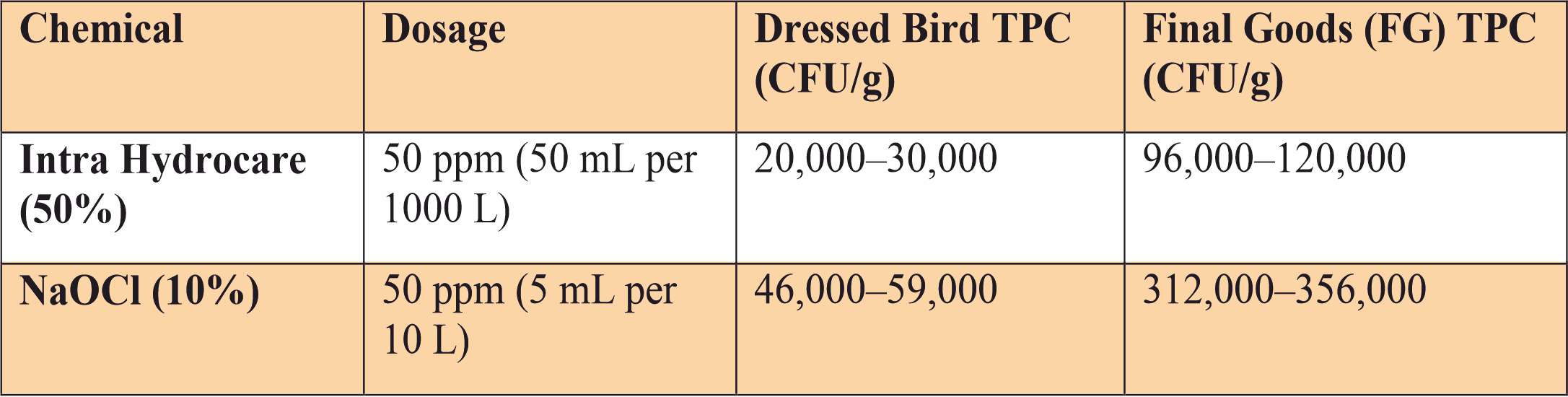
Notes: TPC expressed as CFU/mL for water and CFU/g for carcass rinses. n = 12 sampling events per treatment group.
These results indicate that Intra Hydrocare provided 2–3-fold lower microbial contamination compared with NaOCl, both at the dressed-bird stage and in final goods (FG), demonstrating sustained antimicrobial activity even under high organic load.
2. Biofilm control, scale reduction, and equipment integrity
Significant differences were observed in chiller hygiene and equipment condition:
a) Biofilm disruption: Intra Hydrocare effectively penetrated and destabilized biofilm layers, reflected in markedly lower ATP values.
b) Surface hygiene: Surfaces treated with Intra Hydrocare remained visibly cleaner, with less organic residue accumulation.
c) Scale formation: NaOCl-treated chillers exhibited noticeable scaling, mineral deposits, and structural dulling, which can entrap microorganisms and reduce sanitation efficiency.
d) Equipment protection: Intra Hydrocare’s non-corrosive nature prevented metal surface degradation and eliminated scaling, reducing the need for frequent maintenance.
Overall, Intra Hydrocare improved operational efficiency, minimized downtime related to cleaning, and contributed to extending equipment service life.
Discussion
The findings of this field trial demonstrate that Intra Hydrocare provides superior sanitation performance compared with sodium hypochlorite (NaOCl) in poultry screw chillers. The stabilized hydrogen peroxide formulation used in Intra Hydrocare, i.e., chelated and silver-stabilized, exhibits several mechanistic advantages that directly contribute to its enhanced performance. Its oxidative mode of action functions effectively across a broad pH range (pH 3–8), providing greater stability in the slightly alkaline conditions common in poultry chillers. This contrasts with NaOCl, whose antimicrobial efficacy diminishes rapidly outside acidic-to-neutral pH ranges and is highly susceptible to neutralization by organic matter present in post-evisceration water.
The trial results demonstrated that Intra Hydrocare maintained >99.9% microbial reduction throughout the chilling cycle, while NaOCl showed a steep decline in performance, losing nearly half of its free chlorine activity before reaching the outlet point. This decline directly corresponded with higher Total Plate Count (TPC) values and diminished sanitation consistency. The enhanced biofilm disruption observed with Intra Hydrocare, reflected by an 85% reduction in ATP values, further underscores its efficacy. Biofilms are notorious for harbouring Salmonella, Campylobacter, Listeria, and spoilage organisms; therefore, effective biofilm control is essential for maintaining plant hygiene and reducing persistent contamination.
A notable advantage of Intra Hydrocare lies in its silver-chelated stabilization, which creates oxidative synergy and promotes deeper penetration into biofilm matrices. This capability addresses a critical weakness of NaOCl, which often requires dose escalation (to 100–150 ppm) in real-world settings to overcome organic load and biofilm protection. However, elevated NaOCl dosing frequently causes adverse sensory changes in poultry meat, including chlorinous odours, yellow discoloration, and surface bleaching, leading to quality downgrades or batch rejections. In contrast, Intra Hydrocare delivered robust disinfection at a low, constant 50 ppm, with no detectable impact on odour, taste, colour, or texture.
From an operational perspective, Intra Hydrocare provided significant additional benefits. Its non-corrosive chemistry prevented structural degradation of stainless-steel surfaces, eliminated scale accumulation, and even removed pre-existing mineral deposits. NaOCl, conversely, contributed to scaling and surface dulling, increasing equipment maintenance burdens. These hygiene and equipment advantages align with sustainability and quality certification goals, including organic production standards (USDA NOP, EU Organic) and NSF/ANSI 60 compliance.
Operator safety was another area where Intra Hydrocare exhibited clear superiority. NaOCl exposure is well-documented to cause eye irritation, respiratory discomfort, and bleaching of clothing, all of which were reported by plant operators. Intra Hydrocare, being residue-free and odourless, eliminated these hazards while still requiring standard PPE under HACCP protocols.
Collectively, the trial outcomes highlight several tangible plant-level benefits associated with switching to Intra Hydrocare, including, lower microbial contamination pressure, improved biofilm and scale control, enhanced product sensory quality and shelf-life potential, reduced equipment corrosion and maintenance downtime, safer working conditions for operators and alignment with modern sustainability and certification frameworks.
The primary limitations of this study include the higher initial dosing volume required for Intra Hydrocare (although mitigated by dosing efficiency and longer-lasting activity) and the need for broader multi-site validation to confirm scalability across different processing environments. Additionally, pathogen-specific analyses, such as Salmonella or Campylobacter enumeration, were not conducted in this phase, although the substantial reductions in indicator organisms and ATP strongly suggest improvements in overall contamination control.
Conclusion
This investigation affirms Intra Hydrocare as a transformative sanitizing agent for poultry screw chiller operations, delivering superior performance across all critical sanitation dimensions. By consistently outperforming NaOCl in microbial reduction, biofilm disruption, equipment hygiene, and sensory preservation, Intra Hydrocare enhances both food safety and product quality throughout the poultry value chain. Its non-corrosive, residue-free, and operator-safe characteristics position Intra Hydrocare as an ideal disinfectant for modern, certification-driven poultry processing plants. The observed improvements, ranging from lower microbial loads to better shelf-life potential, translate directly into enhanced customer satisfaction and stronger market competitiveness.
Adopting Intra Hydrocare represents a strategic shift toward resilient, sustainable, and high-performance sanitation systems, advancing the dual goals of operational efficiency and public health protection. By embracing such next-generation biocidal technologies, poultry processors can ensure safer workplaces, superior consumer experiences, and a robust compliance posture in increasingly demanding regulatory and retail environments.
References
Alvarez-Ordóñez, A., Coughlan, L.M., Briandet, R. and Cotter, P.D., 2019. Biofilms in food processing environments: challenges and opportunities. Annual Review of Food Science and Technology, 10(1), pp.173-195.
Amiri, F., Mesquita, M.M. and Andrews, S.A., 2010. Disinfection effectiveness of organic chloramines, investigating the effect of pH. water research, 44(3), pp.845-853.
Agnello et al. Published: June 2012 Journal: Journal of Food Science (Vol. 77, Issue 6, pp. M296-M302)
Buncic, S. & Sofos, J.N., 2012. Interventions to control Salmonella contamination during poultry, cattle and pig slaughter. Food Research International, 45(2), pp.641–655.
EFSA, 2024. European Food Safety Authority. The European Union One Health 2023 Zoonoses Report. (Weblink: https://www.efsa.europa.eu/en/efsajournal/pub/9106)
Gretchen Marlene Nagel Published: August 2012 Source: Auburn University Electronic Theses and Dissertations (M.S. Thesis, Department of Poultry Science)
Hurlbut et al. Published: 1983 Journal: Poultry Science (Vol. 62, Issue 7, pp. 1392-1397)
Kim, J.M., Zhang, B.Z. and Park, J.M., 2023. Comparison of sanitization efficacy of sodium hypochlorite and peroxyacetic acid used as disinfectants in poultry food processing plants. Food Control, 152, p.109865.
Kumar et al. Published: September 2023 Journal: The Pharma Innovation Journal (Vol. 12, Issue 9S, Part E, pp. 206-255)
Na et al. : The Effect of Washing and Packaging on the Quality of the Breast Meat from Old Hen
Scallan, E. et al., 2011. Foodborne illness acquired in the United States—major pathogens. Emerging Infectious Diseases, 17(1), pp.7–15.
Stearns, R., Freshour, A. and Shen, C., 2022. Literature review for applying peroxyacetic acid and/or hydrogen peroxide to control foodborne pathogens on food products. Journal of Agriculture and Food Research, 10, p.100442.
Waters, B.W. and Hung, Y.C., 2014. The effect of organic loads on stability of various chlorine-based sanitisers. International Journal of Food Science and Technology, 49(3), pp.867-875.